

Long gone are the days of just getting by on spotty, unreliable campground Wi-Fi. The best RV internet solutions today are a smart mix of cellular, satellite, and specialized hardware, all working together to give you fast, dependable connectivity for remote work, streaming, or just staying in touch from pretty much anywhere.
Why Reliable RV Internet Is No Longer a Luxury
Not too long ago, having internet on the road was just a nice little perk—a way to quickly check emails or map out your next stop. Now? It’s as essential as your power and water hookups. The modern RVer isn't just on vacation; they're often remote workers, digital nomads, and families who need a solid, high-speed connection to run their lives.
We’ve all been there—the pixelated video calls from a national park or that dreaded buffering wheel spinning endlessly during movie night. This constant hunt for a decent signal can really get in the way of the freedom that RV life is supposed to be about. Finding the right internet setup is what truly unlocks that seamless, work-from-anywhere, travel-anywhere experience.
The Shift to a Connected Lifestyle on Wheels
The demand for good RV internet has absolutely exploded, and it’s all because of a huge shift in how we travel and work. This isn't just about convenience anymore; it’s a flat-out necessity.
A few key trends are driving this change:
- The Rise of Remote Work: Professionals from every field are swapping their cubicles for mobile offices. That means they need stable internet for video meetings, cloud apps, and staying connected with their teams.
- The Digital Nomad Movement: More people and families are hitting the road full-time, and that lifestyle is only possible with a dependable connection for work, school, and keeping up with friends and family.
- Modern Entertainment: Let's be real, streaming services, online gaming, and social media are how we unwind. These things demand way more bandwidth than most free campground networks can ever hope to deliver.
This isn't just a feeling; the numbers back it up. In a major survey, RV owners made it crystal clear that reliable internet is a non-negotiable. The post-pandemic boom in remote work has only poured fuel on that fire, and travelers now expect their connectivity needs to keep growing. You can dive into the details of what RV owners are looking for in this survey. #rv #rvlife #rvliving #rvlifestyle #rvrenovation #rvremodel #rvtravel #rvcamping #rvadventures #ruralwifi #5gwifi #5ginternet
At the end of the day, a strong connection is the bridge between the freedom of the open road and the needs of modern life. It lets you work, learn, and relax without compromise, turning any beautiful vista into a fully functional office or movie theater.
Trying to sort through RV internet options can feel like reading a map in the dark. You've got 5G, satellite, hotspots... all throwing a bunch of technical terms and promises your way. It's easy to get lost.
Let's cut through the noise. We'll break down the top three choices—5G Cellular, Satellite, and Mobile Hotspots—so you can see which path is the right one for your adventures.
Think of them like different vehicles for your data. Each is built for a specific terrain and purpose. Some are great for well-paved highways, others for remote backcountry roads. The best choice for you really just depends on where you're going and what you need to do once you get there.
5G Cellular: The All-Purpose Highway Cruiser
For most RVers who stick to areas with at least some cell service, 5G cellular is the versatile, high-speed connection you're looking for. It uses the same networks as your smartphone but with much beefier hardware, pulling in a stronger, more stable signal for your whole rig.
It's like a sleek, modern sedan that’s perfect for cruising America's highways. It’s fast, reliable, and comfortable for everyday use, whether you’re working from a city campground or streaming a movie near a small town.
- Real-World Performance: When you've got a good 5G signal, the speeds are incredible—often faster than the internet you had back at home. This makes it a beast for demanding tasks like HD video calls, online gaming, or uploading big files.
- Setup Complexity: Getting set up is usually a breeze. Most systems come with a dedicated 5G router that you just plug in, power on, and connect your devices to. It’s about as plug-and-play as it gets.
- Monthly Costs: The cost can vary, but you'll find plans built specifically for the high-data needs of RVers. These are almost always a better deal than just trying to get by on your phone's hotspot plan. You can see how they stack up by comparing different RV internet providers.
#rv #rvlife #rvliving #rvlifestyle #rvrenovation #rvremodel #rvtravel #rvcamping #rvadventures #ruralwifi #5gwifi #5ginternet
Satellite Internet: Your Rugged Off-Road Explorer
If 5G is the highway cruiser, satellite internet is the rugged, 4x4 built for the most remote landscapes imaginable. It completely bypasses cell towers, talking directly to satellites orbiting the Earth. This gets you a connection in places where cell service is just a distant memory.
This is the ultimate solution for boondockers and off-grid adventurers who want true solitude without having to disconnect entirely. Parked deep in a national forest or out in the desert? Satellite can keep you online.
Satellite tech has come a long way, and it’s now a go-to option for many full-timers. Solutions like Starlink are a common sight in the community, offering speeds of 50-150 Mbps for a monthly fee of $120-$150, after the initial $599 hardware cost.
Of course, that off-road capability comes with a few trade-offs. The upfront hardware cost is a lot steeper than a cellular setup. You also need a wide-open, clear view of the sky—trees, buildings, and even a heavy downpour can mess with your signal.
Mobile Hotspots: The Compact and Convenient Sidekick
A mobile hotspot is the quick and easy scooter of the RV internet world. It’s a small, portable gadget that creates a personal Wi-Fi network using a cellular data plan. A lot of RVers start here because they're simple and available from any major carrier.
They’re perfect for weekend trips, as a backup to your main system, or for those times you need internet away from the RV. Just charge it, turn it on, and you’ve got Wi-Fi for your laptop or tablet on the go.
Key Considerations for Hotspots
- Data Caps and Throttling: This is the big one. Most standard hotspot plans have a hard cap on high-speed data. Once you hit that limit, they slow you down to a crawl, making work or streaming next to impossible.
- Device Limits: Hotspots are designed for just a few devices at once. If you try to connect a whole family's worth of phones, laptops, and tablets, things will get slow and frustrating fast.
- Battery Life: They run on batteries, which means one more thing to keep charged. It's another task to add to your power management checklist, especially when you're off-grid.
While a dedicated 5G router is a much more powerful and permanent solution for your rig, a mobile hotspot is still a great tool to have. It's the perfect grab-and-go option for when you just need a quick, simple connection.
RV Internet Solutions at a Glance
To help you see how these options stack up, here’s a quick side-by-side comparison of the most popular internet solutions for RV travelers.
| Solution Type | Best For | Average Speed | Typical Cost | Pros | Cons |
|---|---|---|---|---|---|
| 5G Cellular | All-around use, remote work, streaming in areas with cell service. | 50-250+ Mbps | $599+ (hardware), $90-$150/mo (plan) | High speeds, reliable in populated areas, relatively easy setup. | Requires cell signal, can be congested in crowded areas. |
| Satellite | Boondocking, off-grid travel, working in remote locations. | 50-150 Mbps | $599+ (hardware), $150-$250/mo (plan) | Works almost anywhere, great for remote connectivity. | High initial cost, needs clear sky view, can be affected by weather. |
| Mobile Hotspot | Backup internet, short trips, light use for 1-2 people. | 25-100 Mbps | $100-$300 (hardware), $50-$100/mo (plan) | Portable, simple to use, good as a secondary option. | Strict data caps, battery dependent, connects fewer devices. |
| Campground Wi‑Fi | Basic browsing, checking email, non-critical tasks. | 1-10 Mbps | Usually free | No cost or hardware needed. | Very unreliable, slow, not secure, often unusable for work. |
| Fixed Wireless | Long-term stays in one location with a provider available. | 25-100 Mbps | $100+ (setup), $50-$75/mo (plan) | Stable, reliable connection similar to home internet. | Not mobile; only available in specific rural/suburban areas. |
Ultimately, the "best" solution is the one that matches your travel style and connectivity needs. Many serious RVers even use a combination—like a 5G router for primary use and a satellite dish for those truly off-grid spots—to ensure they can stay connected no matter where the road takes them.
Choosing the Right Setup for Your Travel Style
There’s no magic bullet for RV internet. The perfect solution isn’t about finding the one "best" product, but finding the one that fits your life on the road. A setup that’s ideal for a weekend warrior will leave a full-time digital nomad completely stranded.
Real success comes from matching the tech to your travel habits. To find that perfect fit, you have to be honest with yourself about how you travel. Are you constantly on the move or do you settle in for longer stays? Do you crave remote wilderness, or are you more of a city slicker? Your answers will point you straight to the right gear.
The Full-Time Digital Nomad
When you live and work from your RV, the internet isn't a perk—it's a utility, just like water and electricity. This lifestyle demands a connection that’s fast, stable, and rock-solid for things like video calls, big file transfers, and constant cloud access. A dropped Zoom call or a stalled upload just isn't acceptable.
For this kind of RVer, a layered, multi-pronged strategy is the only way to go.
- Primary System: A high-performance 5G cellular router hooked up to a powerful external antenna should be the heart of your setup. This is your workhorse, ensuring you pull in the strongest possible signal in most places.
- Reliable Backup: Satellite internet, like Starlink, is your ultimate safety net. When you inevitably land in a beautiful spot with zero cell service, you can pop up the dish and be back online in minutes.
- Data Plans: Don’t even think about using a standard phone hotspot plan; they simply won’t cut it. You need to invest in true unlimited data plans from providers who cater to high-usage customers. You might also want to check out our guide on choosing the best portable WiFi for RV setups.
#rv #rvlife #rvliving #rvlifestyle #rvrenovation #rvremodel #rvtravel #rvcamping #rvadventures #ruralwifi #5gwifi #5ginternet
This combination gives you the redundancy needed to work from pretty much anywhere with total confidence.
The Off-Grid Explorer
If your happy place is a campsite miles from the nearest sign of civilization, your needs are completely different. You’re chasing coverage, not necessarily blistering speed. The goal is to have a usable signal for checking weather, staying in touch, and some light browsing, even when cell towers are a distant memory.
Your power system becomes just as critical as your internet hardware. If your travel style involves frequent boondocking, selecting the best RV battery for boondocking is paramount to maintaining consistent internet access and keeping all your devices running smoothly.
For the dedicated boondocker, satellite is the undisputed king. It's really the only technology that delivers reliable, high-speed internet in truly remote areas. A cell booster can be a useful secondary tool—it can amplify a faint, faraway signal—but it can't create a signal out of thin air.
The Weekend Adventurer
When you only hit the road for shorter trips and vacations, the whole equation changes. You need something simple and cost-effective that just works when you need it. You aren't running a business from the back of your rig, so a complex, multi-layered system is probably overkill.
A dedicated 5G cellular hotspot or router often hits the sweet spot. It's a huge step up from spotty campground Wi-Fi or draining your phone's battery, offering plenty of speed and reliability for streaming movies, planning your next stop, and video-chatting with family back home.
This decision tree gives you a quick visual on the core choice: cellular for more populated areas and satellite for when you're truly getting away from it all.
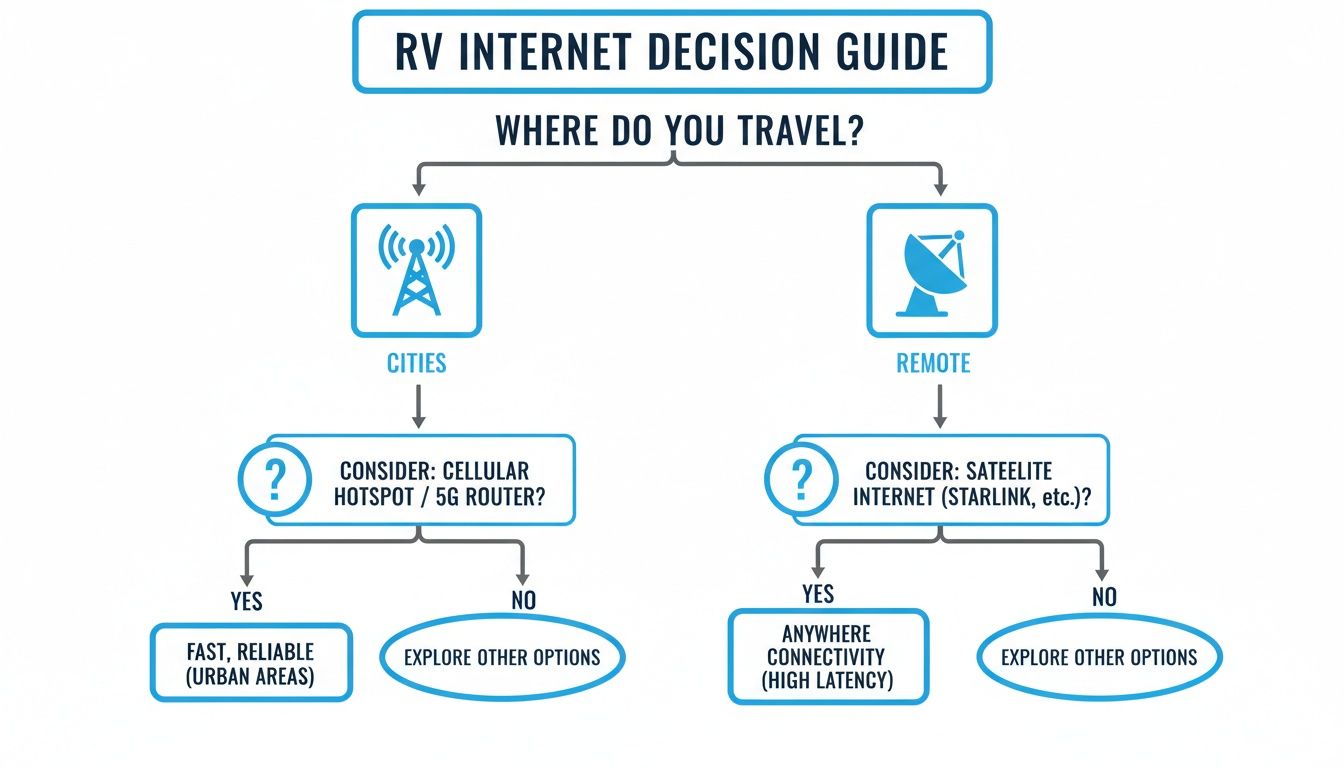
The main takeaway here is that where you spend most of your time—urban centers or the backcountry—is the biggest factor in choosing your primary internet technology.
So many RVers are driven to find their own solutions because shared networks are just plain frustrating. We’ve all been there—the campground Wi-Fi that crawls, especially if you’re far from the office or trying to log on during peak evening hours. This is why personal 5G gateways, which routinely deliver 150-200 Mbps, have become so popular. For boondockers, Starlink is a revelation, offering 50-150 Mbps with low 25-60 ms latency and no data caps. Meanwhile, specialized cellular plans now offer truly unlimited data for heavy streamers. This is where SwiftNet Wifi is changing the game for rural and traveling professionals who need fiber-like speeds, even when they're miles off the grid.
Assembling Your Ultimate RV Connectivity Kit
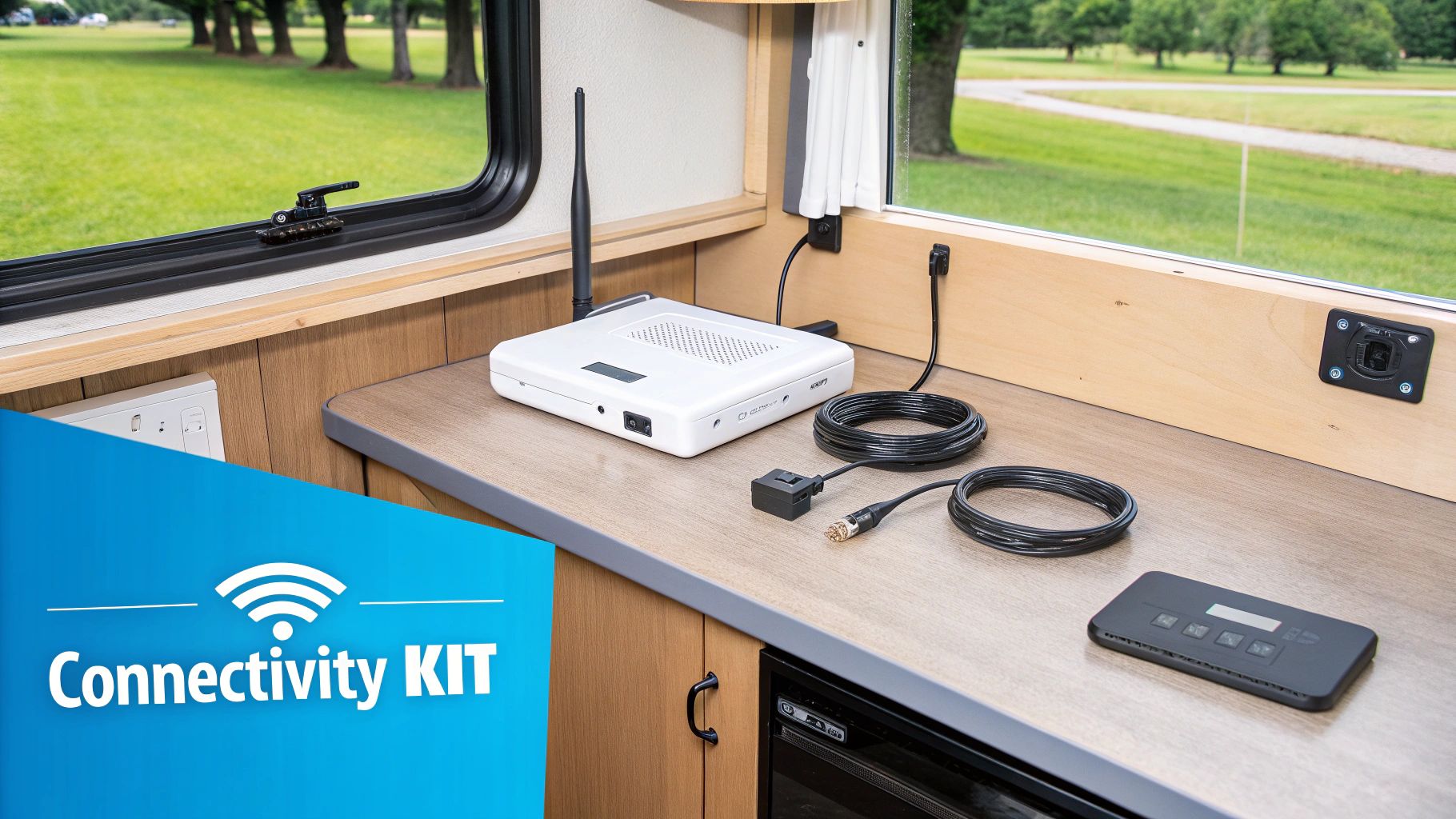
Alright, you’ve picked a primary internet strategy that fits your travel style. Now for the fun part: building out your toolkit. The right hardware is what turns a good plan on paper into a rock-solid, real-world connection you can count on.
Think of it like putting together a specialized gear bag. Each piece has a specific job, and they all have to work together to pull in a signal and deliver fast, stable internet to your rig.
Your setup doesn't need to be crazy complicated. It really just comes down to three core components playing nicely together. Get these right, and you'll have one of the most reliable rv internet solutions out there—strong enough to keep you online whether you're in a packed RV park or parked at a scenic overlook miles from anywhere.
The Router: Your Network’s Brain
At the very heart of any serious RV internet setup is a quality router. And no, this isn't the same box you had sitting on a desk in your sticks-and-bricks home. A dedicated RV or mobile router is the command center, the air traffic controller for all the data flowing in and out of your rig.
Think of the router as the "brain" of your operation. It grabs the internet signal—whether from a cellular tower or a satellite dish—and transforms it into a secure, private Wi-Fi network inside and around your RV. This is what lets your laptops, phones, smart TVs, and everything else connect all at once without stepping on each other's toes.
Key features to look for in an RV router:
- Multi-Carrier SIM Support: This is a game-changer. It lets you pop in SIM cards from different carriers (like AT&T, Verizon, or T-Mobile) so you can switch to whoever has the strongest signal in your current location.
- External Antenna Ports: Absolutely essential. These ports let you connect powerful, high-gain antennas that can dramatically boost your signal reception.
- Wi-Fi as WAN Capability: A handy feature that allows your router to connect to a campground's Wi-Fi, then rebroadcast it as your own secure network. No more logging in every single device.
Antennas: The Ears That Capture Distant Signals
If the router is the brain, then antennas are the powerful "ears." Their whole purpose is to capture faint cellular or Wi-Fi signals from far, far away and feed them to your router with much greater strength and clarity. A good external antenna is often the difference between a frustrating, unusable one-bar connection and a fast, stable one.
You’ll generally run into two types of antennas for RVs:
- Directional Antennas: You have to aim these directly at a cell tower, which can be a bit of a process. But for that effort, they're fantastic at pulling in very distant signals when you’re parked for a while.
- Omni-Directional Antennas: These are the "set it and forget it" option. They grab signals from all directions at once, making them the go-to choice for most RVers since they require no aiming and even work while you're driving.
Investing in a quality roof-mounted antenna is probably the single most effective upgrade you can make to your RV connectivity kit. It gets your signal reception up above nearby obstacles like other RVs and trees that can seriously block and weaken a signal.
Signal Boosters: The Megaphone for Your Connection
Finally, you've got the signal booster, which acts like a "megaphone" for your cell connection. A booster grabs a weak existing signal from outside, amplifies it, and then rebroadcasts that much stronger signal inside your rig. It helps your phone and router "shout" back to the distant cell tower more effectively.
It's really important to know what a booster can and can't do. It can't create a signal out of thin air. But if you have at least a faint, flickering signal outside, a booster can often turn it into a connection that's strong enough for reliable calls, texts, and data.
This three-part system—router, antenna, and an optional booster—is the foundation of a truly capable connectivity kit. By picking components that work well together, you build a powerful, customized solution that tackles the unique challenges of staying connected while living on the move.
Practical Tips for a Stronger Signal Anywhere
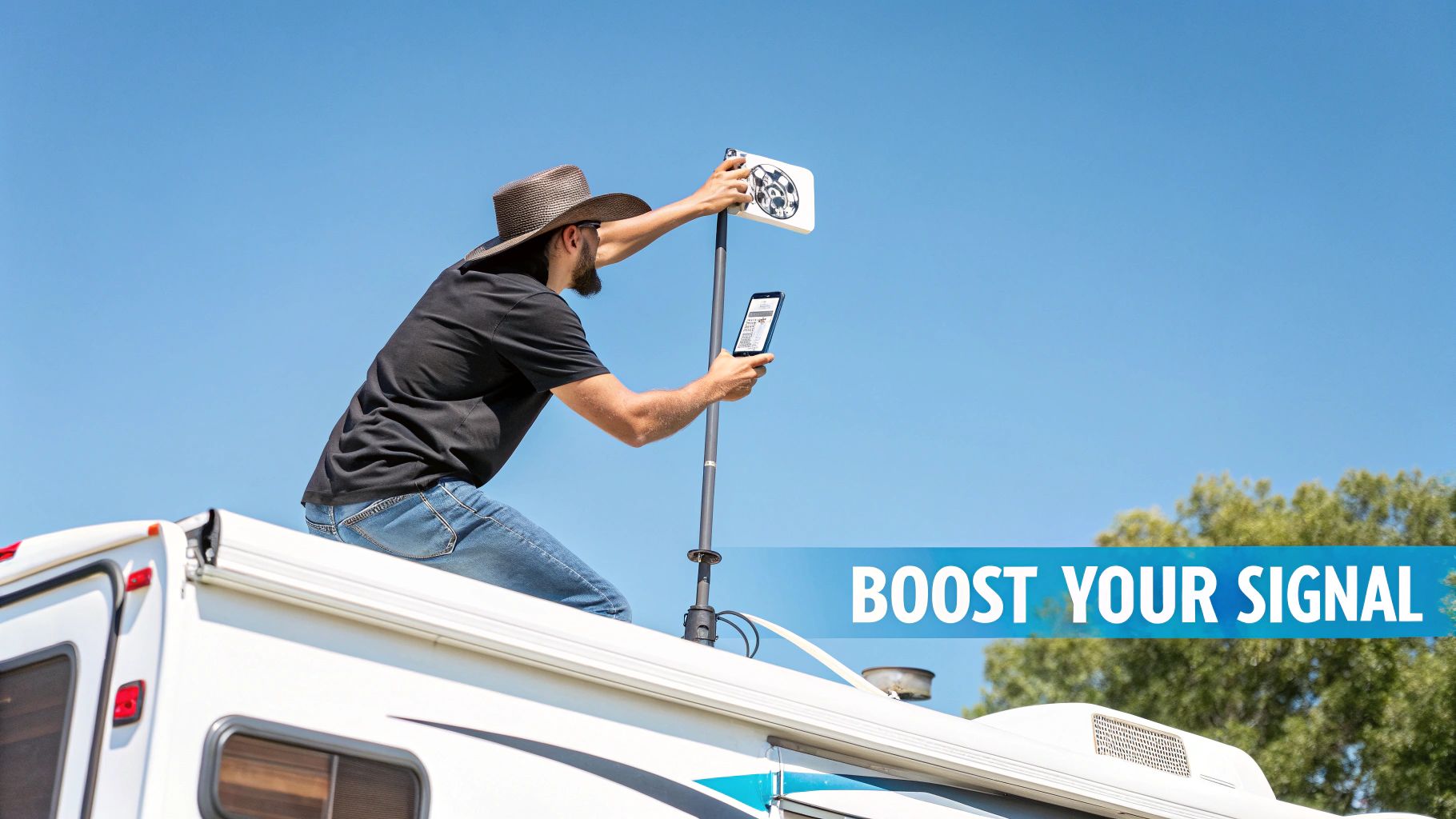
Having the right gear is a fantastic start, but the real magic happens when you know how to squeeze every last drop of performance out of it. This is what separates a frustrating, buffering connection from a great one. These are the field-tested tricks seasoned RVers use to stay online with stable, fast internet, even when the signal bars are looking grim.
You’d be amazed how much of a difference simple adjustments can make. It helps to think of your RV’s walls, windows, and even the rig parked next to you as obstacles blocking your signal. Your job is to give your equipment the clearest possible line of sight to the nearest cell tower, and a few clever tweaks can dramatically boost your speeds.
Master Your Router and Antenna Placement
Often, the single most powerful upgrade you can make costs absolutely nothing—it’s all about location, location, location. Where you put your router and antennas has a massive, direct impact on your internet quality.
Let's start with your router. Just moving it near a window on the side of your rig that faces the nearest town can give the signal a much easier path. Whatever you do, avoid tucking it away in a cabinet or a crowded media console. Those enclosures act like a signal cage, weakening the connection before it even reaches your laptop or phone.
Next up, your external antenna. Getting that antenna up on the roof is a complete game-changer. An elevated position lets it "see" right over nearby obstructions like trees and other RVs, giving it a clear shot to distant cell towers. This move alone can be the difference between one flickering bar and a full, rock-solid connection.
Pro Tip: Remember that a cellular signal is a two-way street. Your device doesn't just receive a signal from the tower; it also has to send one back. A quality antenna in the right spot helps with both, ensuring your uploads are just as snappy and reliable as your downloads.
Use Technology to Your Advantage
You don't have to fly blind and guess where the best signal is. There are a bunch of user-friendly apps out there designed specifically to help you hunt down the strongest connection. For any RVer who depends on good internet, these tools are indispensable.
Here are a couple of the most useful types of apps:
- Cell Tower Locators: Apps like CellMapper or OpenSignal use your phone's GPS to show you a map of nearby cell towers for all the major carriers. This tells you exactly which direction to point a directional antenna to lock onto the strongest signal.
- Speed Test Apps: Running a quick test with an app like Speedtest by Ookla the moment you park can tell you if the signal is usable. If the speeds are slow, you can try repositioning your RV or antenna before you get fully set up and unhooked.
And when you're troubleshooting general connection woes, it can help to get back to basics. If your internet connection is not stable, some foundational knowledge can help you diagnose the most common culprits. #rv #rvlife #rvliving #rvlifestyle #rvrenovation #rvremodel #rvtravel #rvcamping #rvadventures #ruralwifi #5gwifi #5ginternet
Fine-Tune with Signal Boosters
While a great router and antenna combo does most of the heavy lifting, sometimes you just need a little extra muscle. That's where a cellular signal booster comes into play.
If you frequently find yourself in fringe service areas—where you have a very weak but still usable signal—a booster can be a worthwhile investment. You can see what's out there by checking out some detailed cellular signal amplifier reviews to figure out if one is right for your setup. #rv #rvlife #rvliving #rvlifestyle #rvrenovation #rvremodel #rvtravel #rvcamping #rvadventures #ruralwifi #5gwifi #5ginternet
A Few More Questions About RV Internet
Even after you've got a general plan, a few questions always seem to pop up right before you're ready to pull the trigger on a new setup. Let's run through some of the most common ones we hear from fellow RVers. Getting these last few details sorted is the key to hitting the road with total confidence in your connection.
We'll clear up the confusion around "unlimited" data, figure out if a signal booster is right for you, and settle the great 5G vs. satellite debate. This way, you'll know you're putting your money into the right rv internet solutions for your travel style.
Can I Actually Get Unlimited Data for My RV?
Yes, you absolutely can get truly unlimited data for your RV. The trick is to look beyond the standard plans you see advertised for phones. While many hotspot plans from the big carriers come with hidden data caps or will slow you down to a crawl after you use a certain amount, some specialized providers have built plans just for RVers.
These plans are designed from the ground up to handle hours of Netflix, a full day of remote work, and a handful of connected devices without hitting you with surprise slowdowns. It's the kind of peace of mind you need when your connection is your lifeline for work and entertainment.
When Is a Signal Booster a Worthwhile Investment?
A signal booster becomes a total game-changer the minute you start venturing into areas with spotty or weak cell service. It’s best to think of it as an insurance policy for your connection. A booster can't create a signal out of thin air, but it can grab a faint, unusable signal and make it strong and stable.
A booster really proves its worth when you're on the fringes. If you love to boondock, explore remote national parks, or find yourself in campgrounds at the very edge of a coverage map, a booster can turn a frustrating one-bar signal into a solid, high-speed connection.
Now, if you tend to stick to RV parks and campgrounds close to towns and cities with strong cell coverage, a booster might be overkill. But for the serious explorer who pushes the boundaries, it’s an essential piece of gear that can absolutely save the day.
Is 5G a Better Choice Than Satellite for Most RVers?
For the vast majority of RVers, a solid 5G cellular setup is the more practical and versatile choice. It just lines up better with the typical RVer's lifestyle, offering some clear advantages.
Here’s a quick rundown of why 5G usually wins out:
- Lower Latency: This is huge for anyone who works on the road or likes to game online. 5G's snappy response time makes video calls smooth and lag-free, which is something satellite just can't match.
- Lower Upfront Cost: Getting started with a quality 5G router and antenna will almost always be cheaper than buying a satellite dish and the required hardware.
- Fewer Obstructions: This is a big one. 5G signals aren't bothered by trees, which can be a constant headache for satellite users trying to find a clear view of the sky in a wooded campground.
Satellite's big advantage is its nearly universal coverage—if you can see the sky, you can get online. This makes it the perfect fit for dedicated off-grid adventurers who spend most of their time far from any cell tower. For everyone else, a powerful 5G setup delivers the best mix of speed, affordability, and daily reliability for life on the move.
Ready to experience the freedom of truly reliable internet, no matter where you park? SwiftNet Wifi offers high-speed 5G internet solutions designed specifically for RVers and rural residents. Explore our plans today and stay connected on your next adventure! #rv #rvlife #rvliving #rvlifestyle #rvrenovation #rvremodel #rvtravel #rvcamping #rvadventures #ruralwifi #5gwifi #5ginternet


