

At its core, an RV Wi‑Fi booster is a device built to grab a weak, distant internet signal and beef it up, creating a strong, usable connection inside your rig. It doesn't matter if that original signal is coming from the campground's spotty Wi-Fi or a far-off cell tower; the booster's job is to turn "no bars" into a stable connection. Think of it as the essential tool for ending the frustration of bad internet on the road.
Why Weak WiFi Is a Challenge for Modern RVers
The whole idea of hitting the open road has changed. It's not just about unplugging anymore—it's about staying connected, but on your own terms. Today's RVer is often a remote worker taking video calls with a national park in the background, a family streaming a movie on a rainy day, or a traveler mapping out the next leg of an epic journey. In this new world, a solid internet connection isn't a luxury; it's a flat-out necessity.
But here's the catch: our reliance on connectivity often slams head-on into the reality of life on the move. Standard internet setups just can't handle the challenges of remote locations. That feeling of freedom that comes with RV life is constantly threatened by the dreaded spinning wheel of a buffering video or a work call that drops at the worst possible moment.
The Connectivity Gap in RV Travel
The root of the problem is what I call the "connectivity gap"—that frustrating space between where you want to be and where a good signal can actually reach. A few key things create this gap:
- Signal Obstructions: Things like trees, hills, and even the metal and fiberglass walls of your own RV are notorious for blocking or weakening Wi-Fi and cellular signals.
- Distance from Source: It’s simple physics. The farther you park from a campground's router or the closest cell tower, the weaker and less reliable your connection is going to be.
- Network Congestion: Ever notice how the internet grinds to a halt in the evening at a popular RV park? You're not alone. Dozens, sometimes hundreds, of people are all trying to use the same network, leading to painfully slow speeds for everyone.
This digital divide turns what should be a relaxing trip into a constant hunt for a usable signal, often limiting where you can park and for how long. An RV Wi-Fi booster is the bridge across that gap, transforming a faint, useless signal into a strong, dependable connection.
The Rise of the Connected Nomad
This isn't just a hunch; the numbers show a massive shift in how people are living and working. The market for devices like the RV Wi-Fi booster is exploding. Valued at USD 3.24 billion in 2026, it's expected to climb to a staggering USD 5.51 billion by 2031.
With over 11 million RVers hitting the road each year and 40% of them working remotely, reliable internet is no longer negotiable. This trend explains why so many travelers are looking for ways to improve their connection on the road. You can dive deeper into this by checking out our guide on finding better internet for campgrounds. At the end of the day, a booster ensures the freedom of RV life doesn't come at the cost of the connections that truly matter.
How an RV WiFi Booster Turns a Weak Signal into a Strong One
You don't need an engineering degree to get how an RV WiFi booster works. At its core, the whole process is pretty straightforward and boils down to three key stages: capture, amplify, and broadcast. It's a system designed from the ground up to tackle the physical barriers that kill your internet connection on the road.
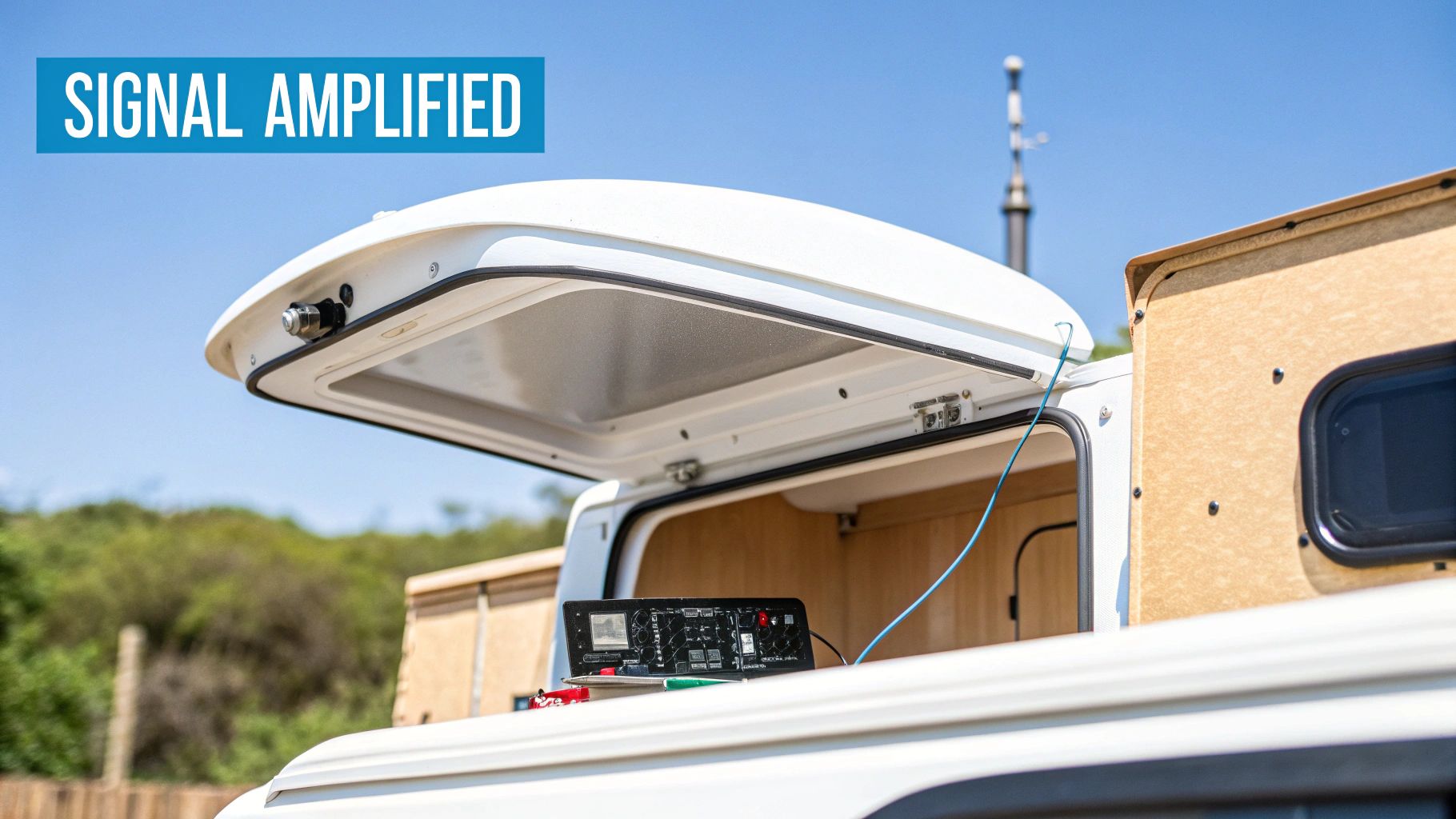
Think of an RV WiFi booster like a powerful hearing aid for your internet. It listens for a faint, distant signal that your phone or laptop can barely hear, then turns up the volume so all your devices can hear it loud and clear. This simple transformation is what turns a frustratingly weak connection into a stable, reliable one.
This is what lets you stream, work, and browse with confidence, even when you're parked at the far edge of a campground or in a remote spot where signals are naturally weak.
Step 1: Capturing the Faint Signal
It all starts with the external antenna. This is the first and most critical piece of the puzzle. Usually mounted on the roof of your RV, this antenna acts like a big, sensitive ear, specifically designed to listen for distant Wi-Fi or cellular signals.
Its high-up position helps it see over common obstacles like trees, other RVs, and rolling terrain that would normally block the signal from ever reaching your devices inside. This antenna is way more powerful than the tiny one tucked inside your phone or laptop, allowing it to latch onto signals that are otherwise completely out of reach.
Step 2: Amplifying for Strength
Once that external antenna grabs a signal, it shoots it down a cable to the amplifier, which is the real workhorse of the system. The amplifier takes that weak, captured signal and, like a megaphone, cranks up its strength in a big way. This is where the "booster" gets its name.
The amplifier's main job is to increase the signal's power, which is measured in decibels (dB). A higher dB gain means a bigger boost, turning one barely-there bar of service into a strong, multi-bar connection you can actually use.
Now the signal is strong enough to provide a solid internet connection, but it still needs to be shared with all your devices inside the RV.
Step 3: Broadcasting a Personal Network
The final piece is the internal antenna. This component takes the newly strengthened signal from the amplifier and rebroadcasts it, creating your own personal, high-powered Wi-Fi network inside and all around your RV.
From here, your phone, laptop, smart TV, and other gadgets connect to this new, beefed-up network instead of struggling to hear the weak, distant source. It’s this simple three-part system of capturing, amplifying, and broadcasting that creates a bubble of strong connectivity right where you need it most.
To get a better feel for the underlying tech, it can be helpful to understand the principles behind a standard Wi-Fi range extender. While the hardware and application are different for an RV, the core concept of grabbing a weak signal and re-broadcasting a stronger one is the same.
Choosing Your Connectivity Solution
Figuring out the world of RV connectivity can feel a little overwhelming at first, but it really boils down to one simple question: where are you getting your internet from? The best RV Wi-Fi booster for you is all about your travel style. Not every gadget is built the same, and picking the right one means matching the tech to your actual needs out on the road.
Whether you're pulling into a fully-loaded RV park or setting up camp in the middle of nowhere, there's a specific tool for the job. The trick is to understand the huge difference between boosting a local Wi-Fi signal (like from a campground) and boosting a cellular signal from a distant tower.
The Campground Cruiser: Wi-Fi Range Extender
If you spend most of your time in established campgrounds that offer Wi-Fi, a Wi-Fi Range Extender (often just called a Wi-Fi booster) is going to be your best friend. Think of it as a powerful signal-catcher. It uses its big external antenna to grab the campground's weak, distant Wi-Fi signal and then rebroadcasts it as a strong, private network right inside your rig.
This setup is perfect for casual browsing, checking emails, or some light streaming when the campground's signal just can't quite make it to your spot.
- Ideal Scenario: You're parked at the far edge of an RV park, and the free Wi-Fi signal is just too weak for your laptop to pick up on its own.
- Key Benefit: You get to use the free or paid campground Wi-Fi without having to move your RV or hang out in the laundry room just to get a connection.
- Potential Drawback: It can only boost a signal that's already there. If the campground's internet is slow for everybody, the extender will just give you a stronger connection to that same slow network. It's not magic!
The Off-Grid Adventurer: Cellular Signal Booster
For the boondockers, remote workers, and anyone who lives off their cellular data plan, a Cellular Signal Booster is absolutely essential. This device has nothing to do with Wi-Fi. Instead, it captures a faint 4G or 5G cell signal from a tower miles away, juices it up, and then broadcasts that amplified signal inside your RV.
This powerful boost can turn one shaky, unreliable bar of service into a stable, multi-bar connection, making it the go-to choice for staying online far from civilization. It’s the engine that powers a truly mobile office. The demand for this kind of freedom is exploding. The specialized RV antenna market, which is the backbone of these boosters, is expected to grow at a healthy 10.5% CAGR starting in 2025. This growth is a direct response to the 13.5 million U.S. RV households, with 30% of RVers citing 'poor campground WiFi' as their number one headache. You can read more about these trends in the connectivity solutions for RVs report on reportsinsights.com.
The Primary Powerhouse: Mobile Hotspot
A Mobile Hotspot isn't a booster itself, but rather a primary source of internet. It’s a small gadget that uses its own SIM card and cellular data plan to create a private Wi-Fi network wherever you are. Many RVers, myself included, use a hotspot as their main internet connection, especially when paired with a cellular signal booster to make sure it's getting the strongest signal possible.
A hotspot gives you a dedicated, secure network that you control. That's a huge advantage over sharing a public campground network with dozens of other people. It's your personal internet bubble on wheels.
When you combine a mobile hotspot with a cellular signal booster, you’ve built the ultimate connectivity machine. The hotspot creates the Wi-Fi network, and the booster ensures the hotspot has the strongest possible cell signal to pull from, giving you fast and reliable internet almost anywhere you can dream of parking.
Comparing RV Internet Booster Types
To make this decision a bit easier, let's lay out these three core solutions side-by-side. Your choice here will directly affect how well you can stay connected, so getting a handle on these differences is key.
| Booster Type | Primary Use Case | Pros | Cons |
|---|---|---|---|
| WiFi Range Extender | Capturing and amplifying existing campground or public Wi-Fi. | Cost-effective; lets you use free or cheap Wi-Fi from a greater distance. | Totally useless without a Wi-Fi source; can't fix an already slow network. |
| Cellular Signal Booster | Strengthening weak 4G/5G signals for phones and hotspots. | Works in remote locations; improves call quality and data speeds. | Requires at least a weak cell signal to start with and a data plan. |
| Mobile Hotspot | Creating a personal Wi-Fi network using a cellular data plan. | Secure, private connection; can connect multiple devices you own. | Relies on cellular coverage; data plans can get expensive. |
In the end, picking the right solution is about knowing yourself and your travel habits. Be honest about where you spend most of your time. Are you a weekend warrior who sticks to parks with full hookups, or a full-time nomad chasing solitude off the beaten path? Your answer will point you straight to the perfect RV internet setup for your adventures.
Installing and Optimizing Your RV Wi-Fi Booster
Getting an RV Wi-Fi booster out of the box is just the beginning. The real magic happens when you install and optimize it properly. A good setup can be the difference between a connection that constantly drops and one that lets you stream movies from the middle of nowhere. It's all about working with your environment, not against it, to pull in the strongest signal possible.
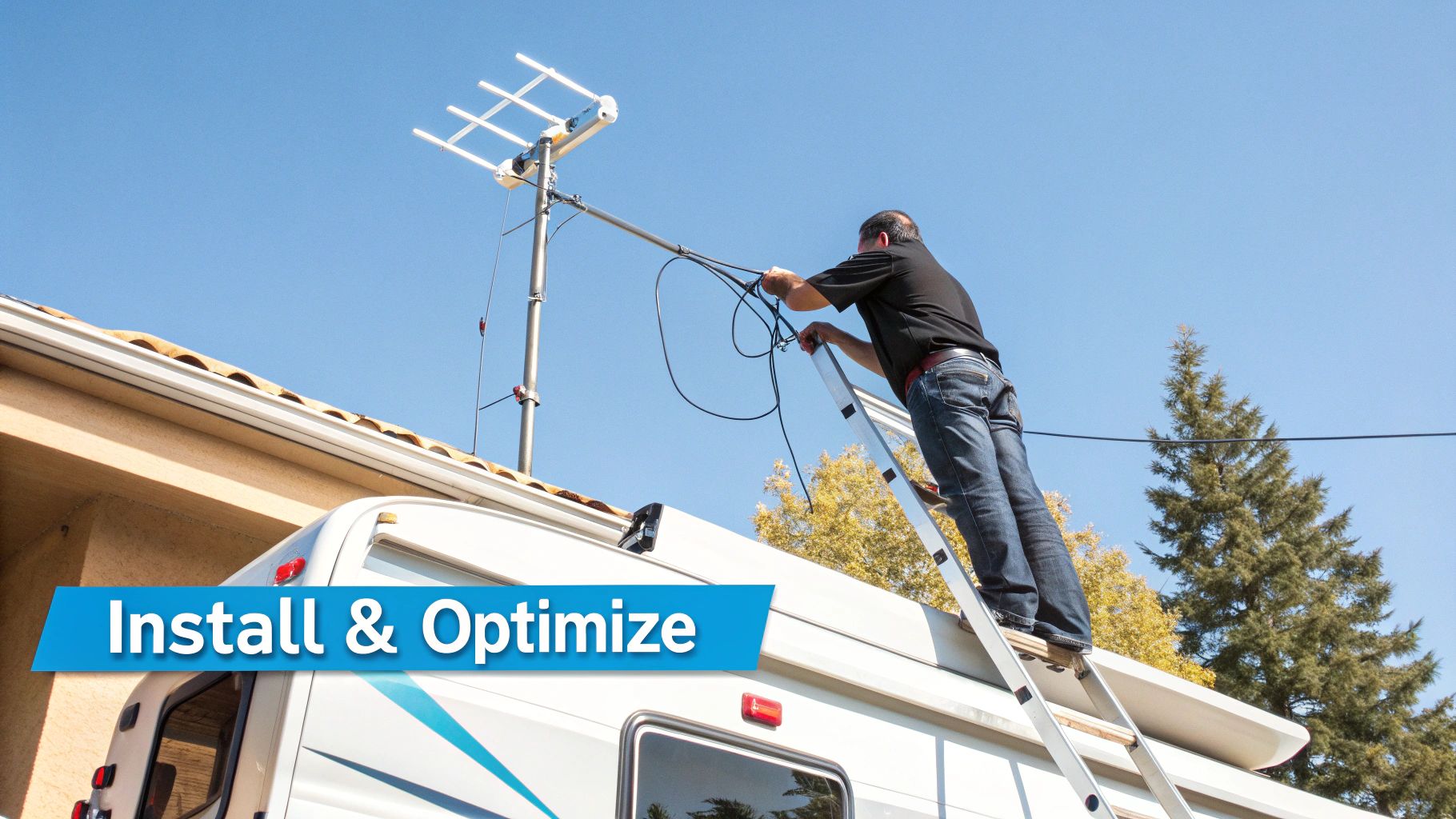
Think of it like tuning an old-school radio. You can have the best receiver in the world, but if your antenna is buried in a closet, you're only going to get static. A well-placed booster system is your ticket to a crystal-clear internet signal, no matter where you decide to park for the night.
It’s no surprise that more and more RVers are investing in these setups. Boosters are part of the home Wi-Fi extender market, which is expected to jump from USD 13.7 billion in 2024 to USD 18.25 billion by 2034. This growth is directly tied to the boom in RVing—with 414,000 new units shipped in the U.S. in 2024 and 62% of owners citing "work-from-anywhere" freedom as a huge reason for their lifestyle. You can read more about the home Wi-Fi extender market on intelmarketresearch.com.
Mastering Antenna Placement
If you remember one thing, make it this: the single most critical factor for a strong signal is where you put your external antenna. This is the part of your system that does all the heavy lifting, grabbing faint signals out of thin air. The golden rule is simple: get it as high as you possibly can.
Height is your best friend. Mounting the antenna on your RV’s roof or an extendable pole lets it "see" over common signal-blocking obstacles like other rigs, buildings, and trees. Every extra foot of elevation makes a real, tangible difference in its ability to lock onto a clean signal from a distant cell tower or campground router.
A critical but often overlooked detail is antenna separation. You have to create as much distance as possible between your external (outside) and internal (inside) antennas. If they're too close, they create a feedback loop called oscillation, where the booster just ends up amplifying its own signal instead of the one you want. Maximize both vertical and horizontal space to keep the signals clean and isolated.
Best Practices for Installation
Once you’ve found the perfect spot, the actual installation requires some attention to detail. A secure, tidy setup doesn't just work better—it holds up to the bumps and rattles of life on the road.
- Secure Mounting: Use the hardware that came with your antenna to mount it securely. It needs to handle highway speeds and whatever weather Mother Nature throws at you without coming loose.
- Smart Cable Routing: Plan your cable route before you start drilling. Run the cable from the external antenna to the internal amplifier, avoiding sharp bends or kinks that can damage the wire and kill your signal. If you have to drill, use weatherproof seals to prevent leaks.
- Protect Your Connections: Make sure every connection is screwed on tight. If any connections are exposed to the elements, wrap them with waterproof tape. A loose or corroded connector is one of the most common culprits for poor performance.
Fine-Tuning Your Connection for Any Environment
Your job isn't done after the initial setup. Every new spot has its own quirks, and a quick adjustment can dramatically improve your connection.
- In a Crowded RV Park: You're fighting a battle against dozens of other signals. If you have a directional antenna, take a minute to aim it straight at the campground’s Wi-Fi source. This focuses its power and helps cut through all the digital noise.
- In a Remote Boondocking Spot: Out here, you're hunting for every last bar of signal. Use a cell signal meter app on your phone to figure out which direction has the strongest signal before you aim your directional antenna. If you have an omnidirectional antenna, your best move is simply getting it higher.
By putting a little thought into how you install and optimize your RV Wi-Fi booster, you're making sure it can do its job. The result? The reliable connection you need to work, stream, and explore with total confidence.
Pairing Your Booster with a High-Speed 5G Plan
An RV Wi-Fi booster is a seriously powerful piece of kit, but it's crucial to remember what it actually does: it can only amplify a signal that’s already there. Think of it like a high-end stereo system—it makes music sound incredible, but it can’t create a song out of thin air. To build the ultimate connectivity setup for your rig, you need a strong, reliable signal for your booster to work with in the first place.
This is where a dedicated high-speed 5G internet service like SwiftNet completely changes the game. Instead of trying to grab and boost inconsistent (and often painfully slow) campground Wi-Fi, you start with a robust, high-bandwidth connection of your own. A service like this provides the strong, original "song" that your booster can then amplify to perfection.
Building Your Ultimate Connectivity Team
It's a common mistake to see a dedicated 5G plan and a cellular booster as an either/or choice. The reality? They’re a powerful team, working together to create an unbeatable mobile office or entertainment hub. They each play a different, but equally critical, role in keeping you connected.
Here’s a look at how they complement each other:
- The Foundation (Your 5G Plan): A high-speed service like SwiftNet delivers a consistent, fast, and secure internet connection directly to your RV over the cellular network. This is your primary internet source, giving you the bandwidth you need for streaming, video calls, and big downloads.
- The Enhancer (Your RV Wi-Fi Booster): The cellular booster’s job is to take that great 5G signal and make it even stronger and more reliable, especially when you're in fringe service areas. It grabs the cellular signal your hotspot or router is using and juices it up, ensuring your connection is firing on all cylinders.
This partnership means you get consistent, fast internet pretty much wherever you roam, from developed campgrounds to more remote hideaways.
Why Starting with a Strong Signal Matters
When you rely on boosting a weak, public signal (like that free campground Wi-Fi), you’re just amplifying an already flawed source. If the campground's network is overloaded and crawling, a booster will just give you a stronger connection to that same sluggish network. It’s like turning up the volume on a fuzzy radio station—it’s louder, but it’s still fuzzy.
But when you pair an RV Wi-Fi booster with a dedicated 5G plan, you’re in control of the source. You start with a high-quality signal that's all yours, not shared with hundreds of other campers. The booster then makes sure this premium signal reaches all your devices with maximum strength and stability, even when the nearest cell tower is miles away.
This two-part approach—a strong 5G plan as the source and a cellular booster as the amplifier—is the secret to creating a mobile internet setup that rivals what you’d expect at home. It removes the uncertainty of public networks and gives you command over your connectivity.
This strategy is especially effective now, as modern 5G networks deliver dramatically faster speeds and lower latency than older 4G connections. By making sure your gear can take full advantage of this tech, you're setting yourself up for a far superior online experience. You can learn more about the key differences between 5G and 4G speeds in our detailed article. This combination empowers you to work, learn, and relax from anywhere, confident that your internet won’t let you down.
How to Select the Perfect RV WiFi Booster for You
Choosing the right connectivity gear can feel like you're staring down the final boss battle of RV prep, but it really doesn't have to be that complicated. If you ask the right questions, you can cut straight through the marketing noise and find the perfect RV WiFi booster for your travel style. It all boils down to being honest about how and where you plan to roam.
The perfect setup for a weekend warrior hitting up full-service resorts is a world away from what a remote worker needs for serious off-grid boondocking. By thinking through your needs now, you can invest in a solution that won't flake out when you need it most. This isn't just about buying another gadget; it's about buying the freedom to stay connected on your own terms.
Start With Your Travel Style
First thing's first: where are you parking your rig most nights? Your answer here will instantly slash your list of options and point you toward the right kind of tech.
- Primarily in Campgrounds: If you stick to established RV parks with amenities, a WiFi Range Extender is probably your best bet. Its whole job is to snatch the park's existing WiFi signal and pull it into your rig, overcoming the distance and metal walls that make that signal so weak.
- Mostly Off-Grid or Remote: For the boondockers and backroad adventurers among us, a Cellular Signal Booster is non-negotiable. This device couldn't care less about campground WiFi. Instead, it strengthens weak 4G and 5G signals from distant cell towers, which is exactly what you need when you're the source of your own internet.
Assess Your Connectivity Needs
Next up, get real about how you actually use the internet. The demands of a solo traveler just checking emails are nothing like a family of four trying to stream movies, game, and video chat all at once.
How many devices need to get online simultaneously? A simple setup might be fine for a phone and a laptop. But if you're juggling multiple smartphones, tablets, a smart TV, and computers, you're going to need a more robust system. That often means pairing a cellular booster with a capable mobile router that can handle all that traffic without grinding to a halt.
Think about your data-heavy activities. If work video calls or streaming in HD are part of your daily routine, a cellular-based solution will almost always beat relying on shared campground WiFi, which is notoriously slow and unpredictable.
Key Features to Look For
Once you know which type of booster you're after, you can start comparing specific models by looking at a few key specs. These numbers tell the real story of a booster's power.
- Gain (dB): This is the single most important number to look at. Gain measures the booster's amplification power in decibels (dB). A higher dB rating means a more powerful boost, allowing the device to turn a barely-there signal into a strong, usable one. For cell boosters, you'll want to look for models with 65 dB to 70 dB of gain for the best performance.
- Antenna Type: Your antenna choice really matters. Omnidirectional antennas grab signals from all directions, which is super convenient for setup. Directional antennas, on the other hand, have to be aimed at a signal source, but they deliver way more power and range. They're the go-to for really remote spots.
- Carrier Compatibility: For any cellular booster, make sure the model you pick works with all the major carriers (like Verizon, AT&T, and T-Mobile). This gives you the flexibility to switch providers or just grab a signal from whatever tower happens to be in range of your campsite.
Making an informed choice here means you get a reliable connection that’s a perfect match for your adventure. For a closer look at specific models, check out our in-depth cellular signal booster reviews to see how the top options stack up.
A Few More Questions About RV WiFi Boosters
Even after you've done your homework, a few questions always seem to pop up when you're trying to get your RV's internet just right. Let's walk through some of the most common ones to clear up any lingering confusion so you can choose your gear with total confidence.
Will a Booster Create Internet Where There Is Zero Signal?
This is probably the most important thing to get straight: an RV WiFi booster is an amplifier, not a creator. It has to have something to work with. For a cellular booster, that means you need at least one shaky, barely-usable bar of service outside your rig for it to grab onto and strengthen.
If you’re in a true dead zone with absolutely no signal whatsoever, a booster won’t be able to help. As powerful as they are, they can't make something out of nothing.
This decision tree can help you visualize which solution fits your situation, based on how you travel, how many devices you use, and what your budget looks like.
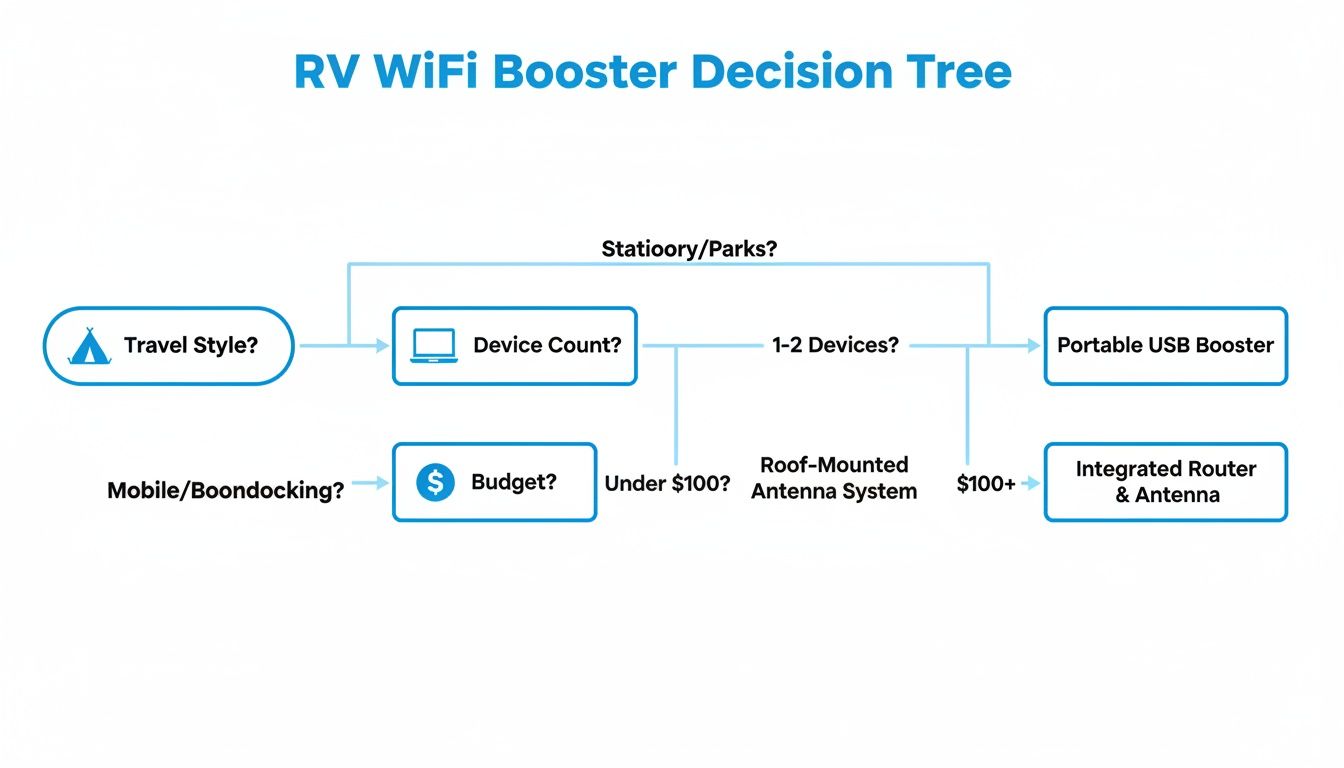
As you can see, your personal needs—whether you're a casual weekend camper or a full-time remote worker—point you toward the right kind of hardware for your adventures.
Can I Use a Regular Home WiFi Extender in My RV?
It might seem like a clever way to save a few bucks, but trying to use a standard home WiFi extender in an RV is a recipe for frustration. Simply put, they just aren't built for a life of bouncing down the highway. They lack the durability to handle the constant vibrations and temperature swings of life on the road.
Even more importantly, a home extender doesn't have the powerful external antennas required to pull in those weak, distant signals from a campground's Wi-Fi tower. An RV WiFi booster is a purpose-built tool, designed specifically for that challenging job.
Does a Cellular Booster Use My Mobile Hotspot Data?
Nope. A cellular signal booster uses zero data. Its only job is to improve the connection quality between your devices (like your phone or a mobile hotspot) and the closest cell tower. Think of it like a stronger, better bridge for the signal to travel across.
All of your data usage is still tracked and billed through your regular cellular plan. In fact, by giving you a more stable signal, a booster can actually make your connection more efficient and faster, but it never consumes any data itself.
Ready to stop wandering around your campsite searching for a signal? SwiftNet Wifi gives you the powerful 5G foundation you need for the ultimate RV connectivity experience. Learn more and find the perfect plan for your travels at https://swiftnetwifi.com. #rv #rvlife #rvliving #rvlifestyle #rvrenovation #rvremodel #rvtravel #rvcamping #rvadventures #ruralwifi #5gwifi #5ginternet


