

In 2024, U.S. manufacturers shipped 237,631 travel trailers, up 15.7% from 205,408 in 2023, according to the RV Industry Association 2024 shipment report. That scale tells you something useful before you compare floor plans. Travel trailers aren't the budget side option, and motorhomes aren't automatically the serious traveler's choice. They're two different ways to organize a vehicle, a home, and your days on the road.
The right pick in a motorhome vs travel trailer decision usually comes down to two questions buyers skip. How many nights will you sleep in it each year, and does it still work when you need a normal car, a quiet desk, and a connection you control? Answer those first and the floor plan gets much easier.
Motorhome vs Travel Trailer at a Glance
Start with the hardware, because every other trade-off grows out of it. A motorhome is built on a self-propelled motor vehicle chassis. The engine, driver's cab, living area, kitchen, bathroom, and beds all live in one titled vehicle that you drive from the front seats.
A travel trailer is the opposite arrangement. It's a rigid, roofed living unit with sidewalls and its own wheels, and it has no engine of its own. You pull it with a separate tow vehicle connected by a hitch, and when you park it, the house and the car can part company.
| Criterion | Motorhome | Travel trailer |
|---|---|---|
| How it moves | Engine and drivetrain built into the RV | Pulled by a separate tow vehicle and hitch |
| Who can be aboard while moving | Driver and passengers in approved seats only | No occupants in the trailer |
| Errands after setup | Drive the coach or tow a separate car | Unhitch and use the tow vehicle |
| What must match | Length, height, and state license rules for that coach | Loaded weight to the tow vehicle rating, plus a proper hitch |
| Build types in this comparison | Type A bare chassis, Type B van, Type C cutaway | Conventional bumper-pull trailer; fifth-wheels are separate |
| Internet pattern | Equipment travels with a vehicle you may drive daily | Parked trailer can work like a small house while the car is free |
The Three Motorhome Builds, in Plain Terms
Motorhomes come in three construction types. RV Industry Association material on motorhome types identifies Type A coaches built on a bare motor-vehicle chassis, Type B campers built on an automotive-grade van chassis, and Type C coaches built on a cutaway automotive-grade truck chassis. That same material defines fifth-wheel trailers separately, because their towing mechanism sits above or forward of the tow vehicle's rear axle, so they fall outside this bumper-pull comparison.
Type B vans are the easiest motorhomes to park and the tightest to live in. Type A coaches give you the most interior room and storage and the most vehicle to maneuver. Type C models sit between them, with a familiar truck-style cab and usually an over-cab bunk.
The core difference isn't size or luxury. It's one vehicle that does everything versus a parked house plus a separate car.
What the Market Actually Buys
The sales picture shows how most buyers sort this out. The RV Industry Association 2025 shipment report counted approximately 342,220 recreational vehicles shipped in 2025, with a total retail value of $20.40 billion. All motorhomes combined totaled about 36,000 units, roughly 10.5% of that volume, while conventional travel trailers led the towable majority.
That gap doesn't make trailers better. It makes them the mass-market foundation of the industry, with more sizes, more used inventory, and more floor plans at any given budget. Motorhomes are the smaller, convenience-oriented segment for buyers who'd rather consolidate everything into one machine.
Two Rules Before You Compare Prices
First, nobody rides in a travel trailer while it's moving, and motorhome passengers belong in approved seats, not stretched out in the living area on the highway. The living space is for when you're legally parked. Plan your travel days around that, especially with kids who expect to sprawl at the dinette.
Second, a lower sticker price doesn't mean a lower cost per night you use. A trailer you already have a truck for is a very different purchase from a trailer that forces a truck upgrade. Likewise, your internet setup has to match how often the rig moves, because equipment in a coach you drive to town behaves differently from equipment in a trailer that stays parked for two weeks.
Cost per Night You Actually Use
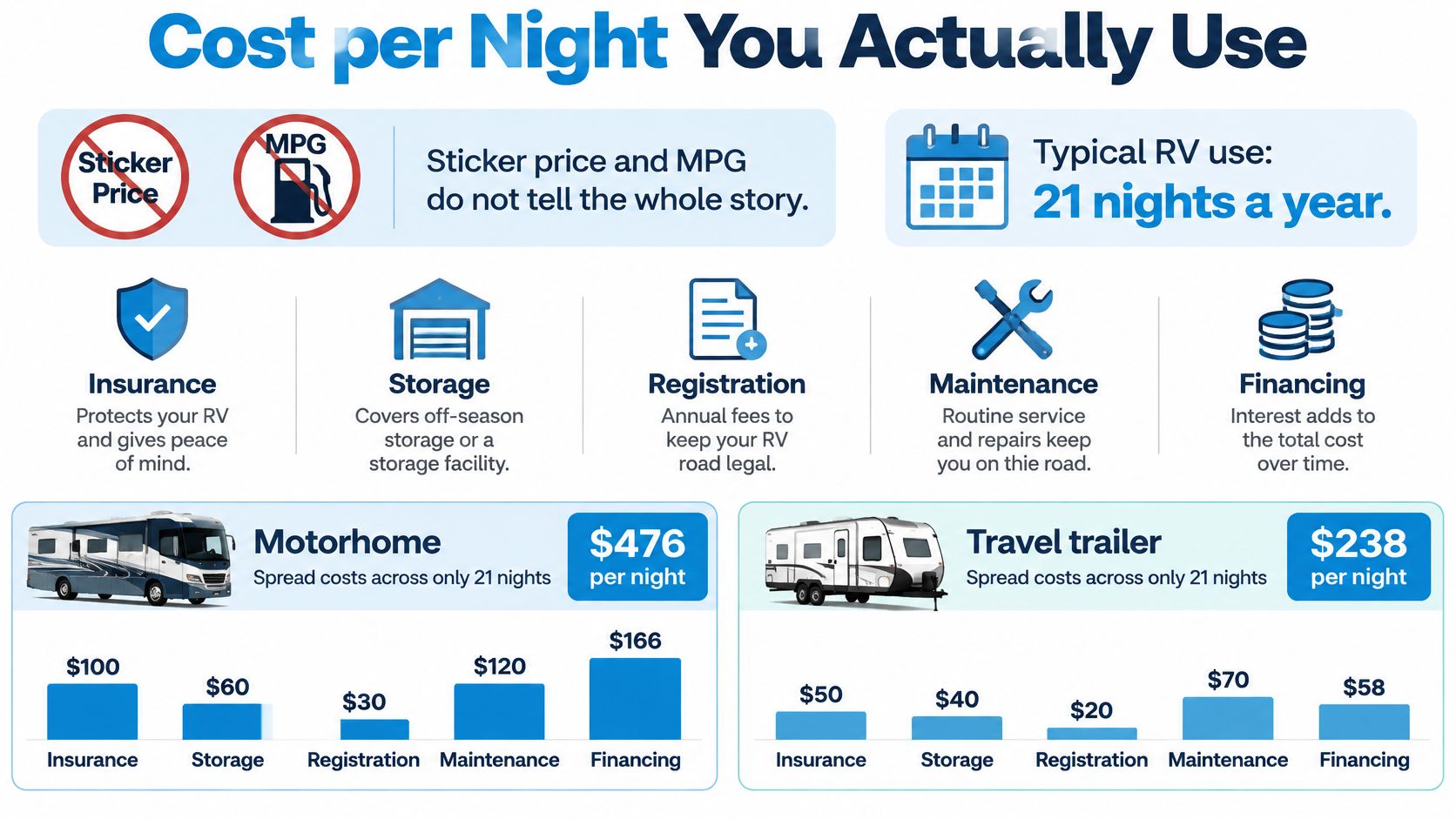
About 21 nights a year is typical use for an RV owner, according to a Kansas City report on RV ownership costs. That figure changes how a purchase looks: annual costs keep accumulating whether the rig is on the road or in storage. Insurance, registration, maintenance, financing, storage, and depreciation all count, so divide those costs by the nights you use the RV, not the nights you hope to use it.
The report also describes a used travel trailer costing about $4,935 a year before trip-specific expenses. At 30 nights of use, that works out to roughly $165 per night. It also notes that 71% of RVers spend under $10,000 annually on total ownership and travel costs, including camping, fuel, and insurance.
How Use Patterns Change the Bill
| Use pattern | Nights a year | Cost signal | Format that usually fits |
|---|---|---|---|
| Typical owner | About 21 | Fixed costs such as insurance, storage, registration, maintenance, financing, and depreciation outweigh fuel | The rig you will actually take out |
| Light seasonal use | About 30 | Used travel trailer about $4,935 a year, or about $165 a night | Travel trailer if a capable tow vehicle is already owned |
| Common spend range | About 21 to most of the year | 71 percent of RVers report under $10,000 a year all-in | Either, if storage, insurance, and any second vehicle stay under the cap |
| Full-time or remote work | Most of the year | Fuel or tow miles plus a monthly data plan | Motorhome for frequent moves; trailer for a parked office |
Start with the nights column. When you use an RV less often, each night carries a larger share of the fixed costs, like dividing an annual bill among only a few trips. In that case, the better fit is usually the rig with lower carrying costs that you will take out. With frequent use, those fixed costs are spread across more nights, and trip costs, comfort, and work needs matter more.
Where Each Format Hides Its Real Price
A travel trailer often costs less to buy, but the purchase price may not include everything needed to use it. If you do not already own a suitable tow vehicle, add the cost of getting one, along with a hitch setup and brake controller. Storage also belongs in the calculation. If you already have a capable tow vehicle, the trailer's lower entry price can be a real advantage.
A motorhome combines the engine and living space in one vehicle, with one insurance policy and one registration. That simplicity comes with a higher purchase price and engine and drivetrain maintenance, even when the motorhome is not traveling. Financing and storing an unused coach can make each night of use costly, just as they can with a trailer.
The break-even question: How many nights will you use it, and do you already own a tow vehicle that can pull it? Those answers shape the cost comparison.
Purchase prices vary by size, age, and region, so a single price range would not fairly compare these formats. Build a budget for the specific rigs you are considering: check local storage costs, get insurance quotes, and include the cost of any car you would tow behind a motorhome. Fuel matters too, but the annual costs that accrue while the RV is parked also deserve a place in the calculation.
For remote work, include the monthly data plan in your per-night budget, just as you would insurance. A rig that moves frequently and one that stays parked as an office can have different work costs. Compare those expenses with your travel pattern before deciding which format offers better value.
Towing Driving and the Car You Have Left
A travel day feels completely different in each format, and that daily friction matters more over five years than most spec sheets. The trailer owner's morning starts with a hitch routine. The motorhome owner's morning starts with turning a key, but ends with a different problem at the grocery store.
The Trailer Setup Sequence
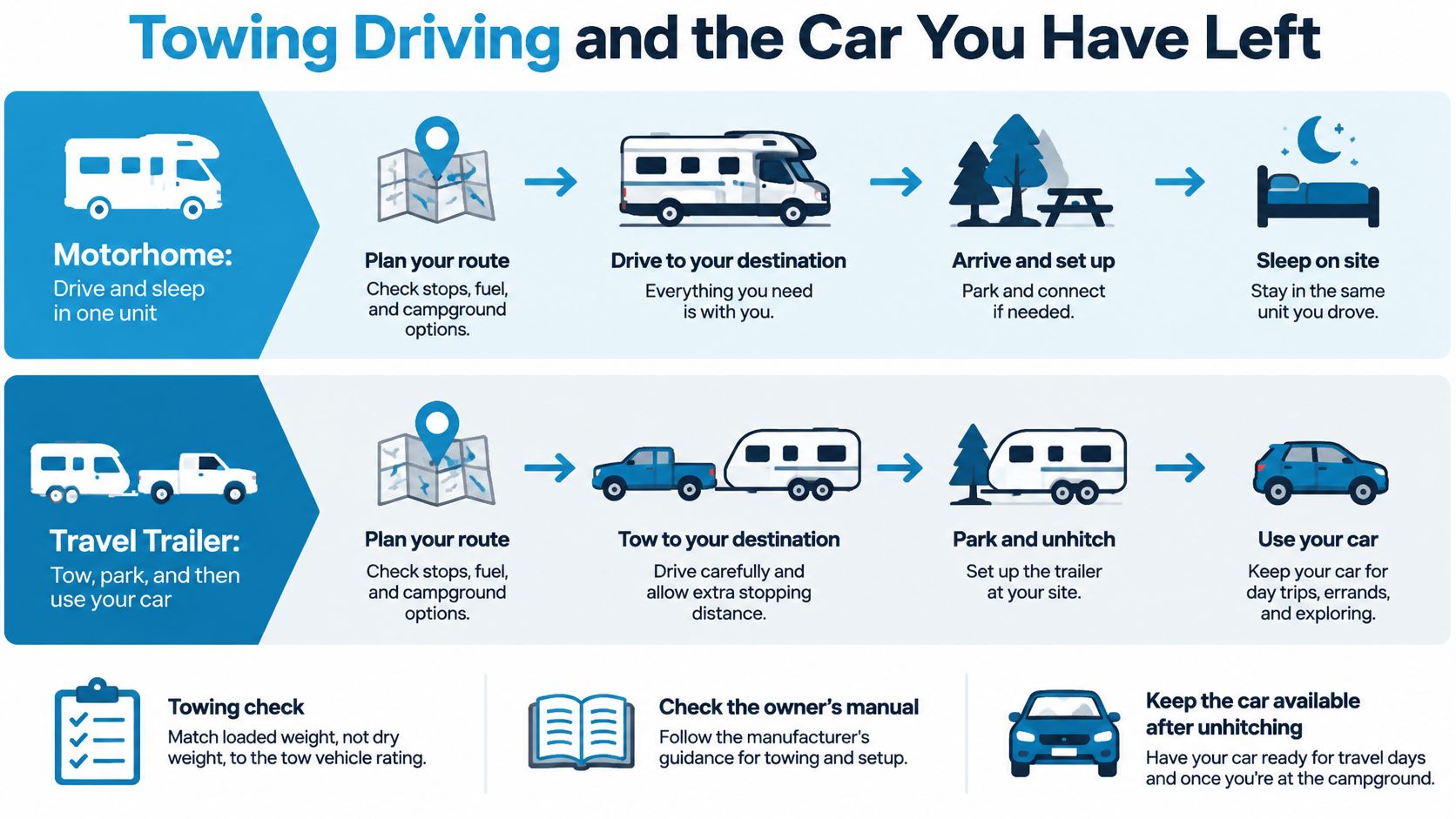
RV Industry Association guidance on choosing an RV says buyers must match the trailer's loaded weight, not its empty or advertised dry weight, to the tow vehicle's rated capacity, and that the longer and heavier the trailer, the larger the tow vehicle generally needs to be. It advises checking the vehicle owner's manual for towing restrictions and having the tow package professionally installed.
Work through it in this order before your first trip:
- Weigh or calculate the loaded trailer, with water, gear, food, and propane aboard, not the brochure number.
- Compare that figure with your tow rating and payload, leaving margin rather than towing at the limit.
- Confirm the hardware, including the correct hitch class, a working brake controller, and mirrors that let you see past the trailer.
- Practice one slow backing maneuver in an empty lot until the steering inputs feel predictable.
That same guidance names the payoff for this work. Once you reach a campsite, you unhitch and use the tow vehicle for local transportation, while a motorhome owner either tows a separate car or drives the motorhome itself on every errand.
The Motorhome Trade
Driving a motorhome removes the hitch, the sway, and the two-vehicle backing problem. In exchange, you're piloting your entire house everywhere, so height clearances, overall length, tight campground roads, and small-town parking all become daily considerations. A quick lunch stop is easy. A quick run into a crowded downtown isn't.
Fuel is a consequence of the architecture rather than a separate contest. You're either moving one heavy coach or moving a tow vehicle plus a trailer, and neither arrangement is light. Judge it after you've settled the driving arrangement you can live with.
Licensing Isn't Automatic
Don't assume a regular driver's license covers every motorhome in every state. The Federal Motor Carrier Safety Administration guidance on RV licensing states that a state may extend commercial-driver-license requirements to people operating recreational vehicles for non-business purposes. Check the rules in your home state and every state on your route, especially with a large Type A coach.
A trailer's hidden cost is hitching time on every move. If you relocate during business hours, that routine eats the middle of your day in a way a motorhome departure doesn't.
That edge case decides real purchases. A couple that moves twice a month barely notices the hitch routine. A solo traveler who changes sites every few days, sometimes between calls, feels every minute of it.
Internet and a Workday in Each Format
For a remote worker, the useful measure is not just how fast a connection can run. It is whether your setup can support calls at the site you choose, stay assembled when you relocate, and leave someone free to run errands. A desk is only an office if the connection and daily routine work together.
What Travelers Expect Versus What Parks Deliver
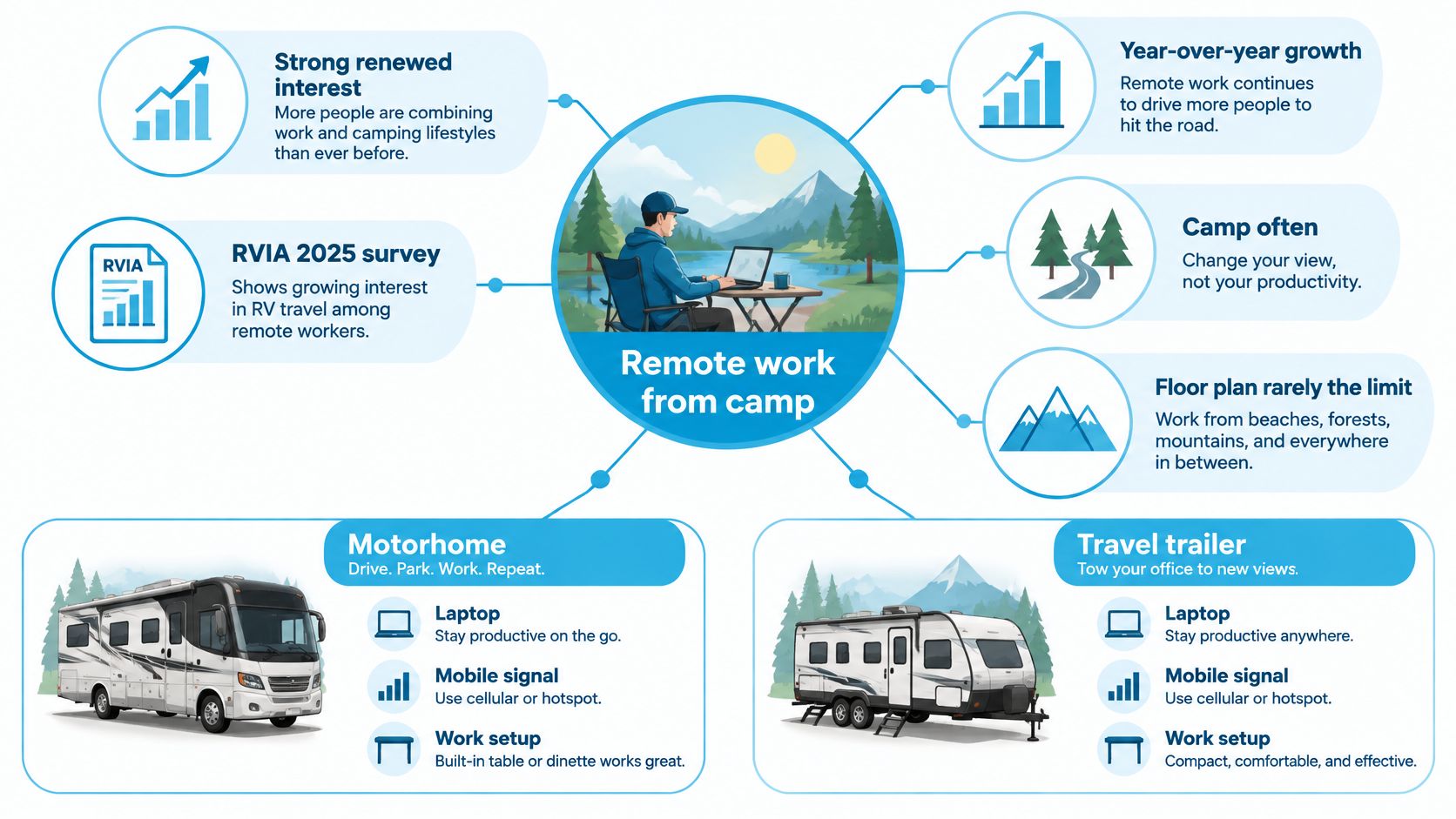
The 2025 KOA camping and outdoor hospitality report found that work while camping had returned to roughly pre-pandemic levels. It also reported that 78% of surveyed travelers expected high-speed Wi-Fi, though most said they used it mainly for entertainment and social sharing rather than remote work. The report points to an expectation gap: wanting fast Wi-Fi does not mean a campground can provide a dependable work connection.
Campground Wi-Fi is shared and may be throttled during busy periods, so treat it as a bonus to check when you arrive, not as the foundation of your workday. Before choosing equipment, understand what internet speed remote work actually requires, then compare that need with the connection available at the sites you plan to use.
A Workday in a Motorhome
A motorhome can keep a desk, monitor, router, and roof antenna assembled during a short relocation. Once you park and level, the office is ready. That saves setup time for travelers who change sites every few days.
The trade-off is that driving time is not work time for anyone aboard, since passengers must use proper seats. And when the coach is your only vehicle, a midday errand takes your office and its connection along. Place the router high and near the center of the coach, power it from the house batteries with a 12-volt supply, and keep the antenna lead short. That setup lets the connection stay available during stops without requiring a full teardown.
A Workday in a Travel Trailer
A parked trailer gives the work area a more settled feel. The router stays in place, an antenna can sit on a mast or ladder mount, and the desk does not have to fold away each time you drive. The tow vehicle is also free for errands while a travel partner remains on calls.
Move days take more preparation: the office must be packed and rebuilt around the hitch routine. For stays of a week or longer, that setup burden is spread across more workdays. In either format, good placement and settings can improve your mobile hotspot speed before you decide that new hardware is needed.
Building the Connection Itself
For many routes, multi-carrier 4G and 5G can provide a practical everyday connection. Coverage gaps differ by carrier, so a route with weak service on one network may work on another. Satellite service is an option where there is a clear view of the sky and cellular service is unavailable. SwiftNet offers a 4G Bronze hotspot and 5G Diamond router plans using virtual SIM technology across AT&T, Verizon, and T-Mobile. The plans start at $49.99 a month, include a 7-day risk-free trial, and have no contract.
The workday difference comes down to how long you stay, whether you must move during business hours, and whether a carrier covers your route. A motorhome keeps the office assembled on travel days; a trailer leaves the tow vehicle available while the office stays parked.
Before settling into a routine, make one practical check: take a real video call on your own connection from a site you expect to use, at the time you expect to work. That reveals whether the connection suits your workday and whether the rig's layout supports it.
Which Travel Pattern Fits Which Rig
Abstract pros and cons won't pick your rig. Your actual weeks will. Here's how four common patterns sort out, with a lean for each and the assumption that would flip it.
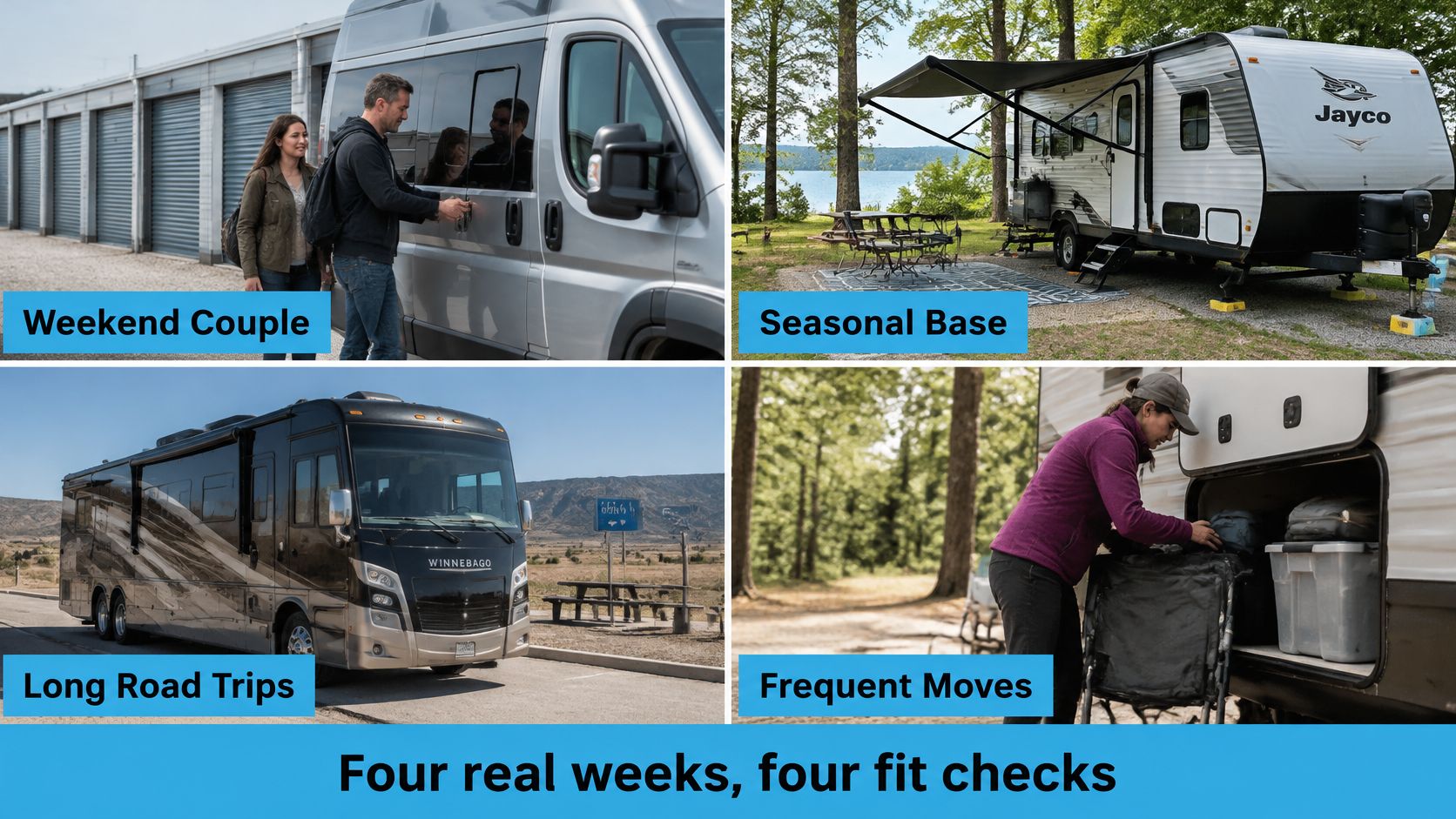
The photos below show how differently these rigs present at a campsite, which is worth a look before the scenarios.
Four Real Weeks
The weekend couple with off-site storage. You keep the RV in a storage lot, leave Friday after work, and want one set of keys and no new skills to learn in the dark. A smaller Type B or Type C motorhome leans right, because there's no hitch practice standing between you and the campsite. The lean flips if storage pricing punishes a tall coach or you already own a capable SUV.
Seasonal travelers who stay put for a week or more. You own a half-ton or heavy-duty truck, book longer stays, and explore by driving out from camp most days. A travel trailer wins this one cleanly. The house stays parked and level while the truck handles trailheads, groceries, and laundry runs.
A family with bikes, a dog, and mixed driving comfort. This one's split. A trailer can give you separate sleeping zones and a familiar family vehicle for day trips, which helps when bedtimes differ. A motorhome removes the need to teach a second driver to back a trailer, which helps when only one adult is willing to tow. Let the less comfortable driver's preference decide, because a rig only one person can move is a fragile plan.
The full-timer changing regions every few days. A motorhome keeps the kitchen stocked, the bed made, and departure simple when you're moving constantly. It only works if you accept driving a large vehicle as your daily transport or towing a small car behind it. If your full-time life means month-long stays instead, you're really in the seasonal pattern above, and the trailer logic applies.
Watching both formats handle a real travel day side by side makes the driving and setup differences easier to judge than any spec sheet.
The right question isn't which rig is better. It's how often you move versus how often you need a normal car.
One constraint outweighs price more often than buyers admit. If your travel partner flatly won't tow, a cheaper trailer isn't cheaper in any way that matters, because every move depends on one person's health, schedule, and willingness. Name that constraint early instead of discovering it at a dealership. If internet at your campsites is part of the decision, it's worth comparing how campground internet options actually perform before you assume park service will cover your needs. From here, run your own pattern through the four checks that follow.
Four Checks First
A rig can look affordable on a dealer's lot and still cost too much for the nights you use it. Before you sign, test your choice against your real travel calendar, vehicle limits, annual budget, and workday connection. Any one of these checks can rule out a poor fit.
Run These in Order
- Count realistic nights. Start with your actual calendar: vacation days, school breaks, and weekends you are willing to give up. Compare that count with the nights you hope to travel. If you expect to use the rig only occasionally, lower fixed costs and easy storage may matter more than extra interior space. A lower purchase price does not help much if the rig sits unused.
- Confirm the tow rating or coach rules. For a trailer, compare its loaded weight with your tow vehicle's rating and leave room to spare. Have the tow package installed professionally rather than assembling it piecemeal. For a motorhome, check its length and height against the campsites you plan to visit, and confirm license requirements for every state on your route. Use the vehicle documents and state requirements, not a salesperson's assurance.
- Price the full annual picture. Get quotes for storage near home and insurance on the specific rigs you are considering. Add registration, routine maintenance, and, for a motorhome with a towed car, the car's insurance and towing hardware. Set an annual spending limit before shopping, then check whether the total works in a quiet travel year as well as a busy one. If mobile data is part of your setup, compare how cellular coverage differs between carriers for the places you expect to travel.
- Test a video call on a connection you control. Choose a campsite you might use, set up as you would on a trip, and make a real call during your usual work hours. Advertised campground Wi-Fi is not a substitute for a test. Shared service can become unreliable when more campers are online, so include equipment and a monthly data plan in your budget from the start.
The choice-changing question is whether your rig must work as a moving workplace or a parked one. Match the connection test to your workday and travel pattern.
Sharing This Guide
If this comparison helped you choose between a motorhome and travel trailer, share it with someone weighing the same decision.
Whichever rig you choose, working on the road depends on having a connection that fits your route and routine. SwiftNet Wifi offers 4G and 5G plans designed for RV travelers and rural households. Check coverage for your planned routes and choose a plan that suits the way you travel.


