

A lot of people start looking for no-contract rural internet on a frustrating day. The DSL line keeps dropping during a work call. The campground WiFi reaches your picnic table but not your laptop inside the RV. A fiber project was promised for your road, but nobody can tell you when it will arrive. You don't want to sign a long agreement just to find out the service can't handle streaming, remote work, or normal family use.
That's where no-contract rural internet makes sense. It gives you a way to get online without tying yourself to a long commitment when your address, travel plans, or local coverage could change. For some people, it becomes the main home connection. For others, it's a practical backup, a seasonal setup at a cabin, or a travel-ready option for RV life.
Rural access gaps are real, not just inconvenient. The FCC reported that rural fixed broadband availability at 25/3 Mbps rose from 45.7% in 2012 to 77.7% in 2018, but 22.3% of the rural population still lacked access in 2018, compared with about 1.5% of the urban population at that benchmark, according to the FCC broadband availability summary. Even when internet exists, your practical choices may still be limited.
The tricky part is that “no contract” doesn't always mean “easy to leave.” A provider might skip the annual agreement but still lock you in through device payments, expensive equipment, or a setup that's hard to reuse if you move. That's what confuses many first-time buyers.
Introduction to Flexible Internet for Rural Life and Travel
A rural internet decision often starts in the middle of real life. Schoolwork is due tonight. A work call starts in an hour. The RV is parked somewhere new, and yesterday's decent signal means nothing at this stop.
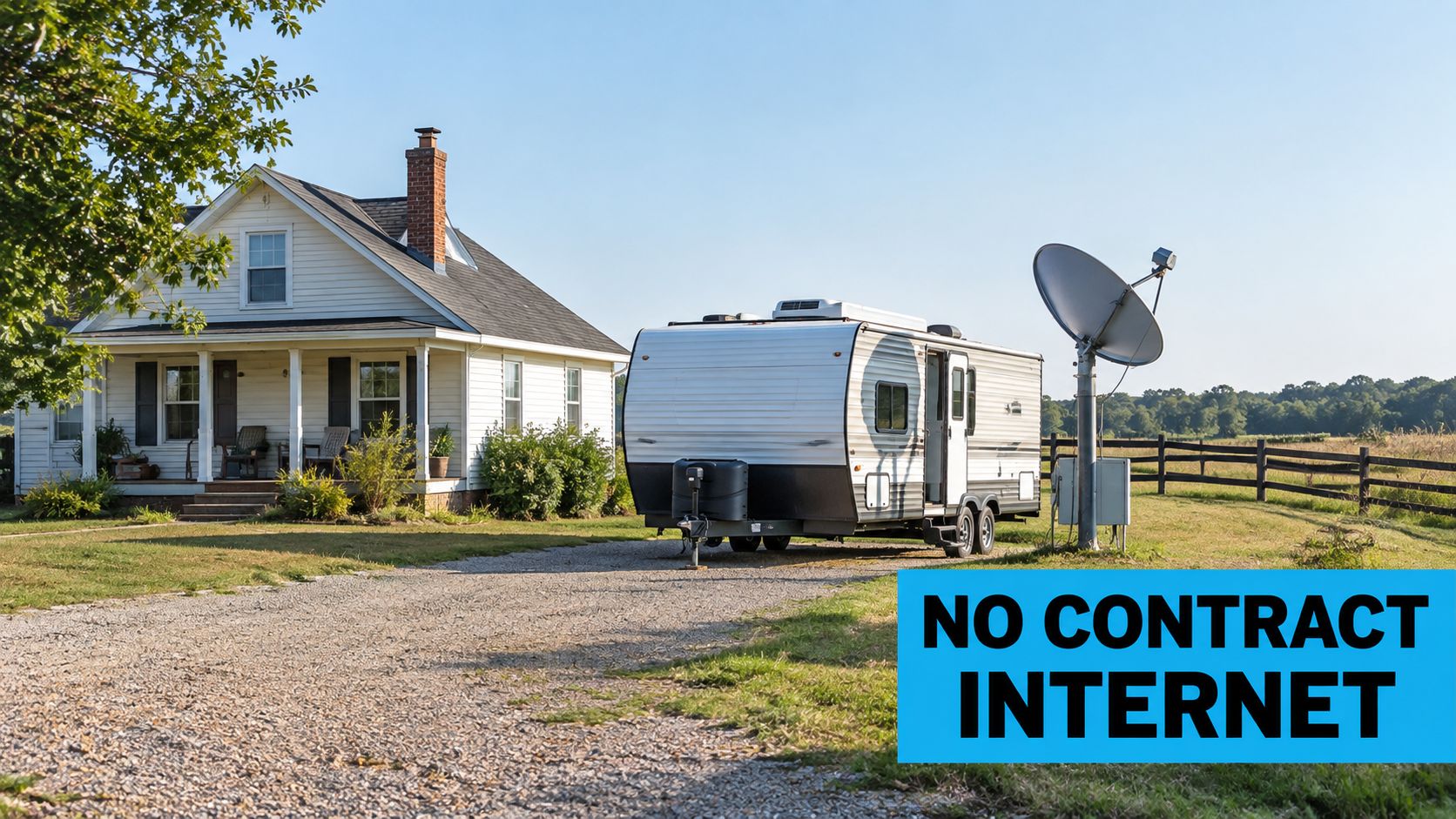
For rural homes and travelers, “no contract” sounds simple, but the question is bigger. You are usually trying to buy flexibility without paying a hidden price for it later. That can mean avoiding a long service term, but it can also mean watching for financed equipment, return fees, weak local coverage, or a plan that works in one county and falls apart in the next.
That difference matters more outside towns and suburbs, where internet options can change road by road. As of December 2023, about 19% of households in nonmetro areas and 17% of households in tribal areas lacked fixed terrestrial broadband at 100/20 Mbps, compared with 4% of households in metro areas. The same FCC broadband progress report also noted that even where higher-speed tiers were available, many households subscribed to lower benchmarks instead. In plain terms, availability and usable value are not the same thing.
That is why contract-free internet appeals to people in the country and on the road. A month-to-month plan can work like a test drive. You can see how a connection handles your actual driveway, your metal-roof home, your tree cover, your commute, or your RV route before you sink money into the wrong setup.
Why flexibility matters differently in rural and RV use
At a city apartment, switching providers may be mostly about price. In rural life, the bigger problem is fit. One carrier may reach your porch but struggle inside the house. Another may be fine at home and unreliable at the lake cabin. An RV traveler may get solid speeds at one campground and almost nothing two hours later.
Coverage maps help, but they are not the whole story.
Rural buyers also run into a problem many guides skip. A plan can be sold as no contract and still cost money to leave. If the gateway is financed over many months, or if the hardware only works with that provider, your exit is not as cheap or as easy as the ad suggests. For a home user waiting on fiber, that matters. For an RV owner who may switch carriers by season or travel route, it matters even more.
Who usually gets the most value
Contract-free internet often fits people who need room to adapt:
- Rural households with limited wired choices. You need something usable now, while local options remain uncertain.
- RV travelers, campers, and mobile workers. Your connection has to follow you, and one carrier rarely performs the same everywhere.
- Remote workers in mixed-signal areas. A plan may look good on paper but still fail during video calls, uploads, or VPN use.
- Seasonal property owners. A cabin or second home may not justify year-round service or expensive equipment that sits idle.
The main idea is simple. No-contract internet is less about escaping paperwork and more about keeping your options open without getting trapped by the true cost of leaving.
What No Contract Rural Internet Really Means
The easiest way to understand no-contract internet is to compare it to housing.
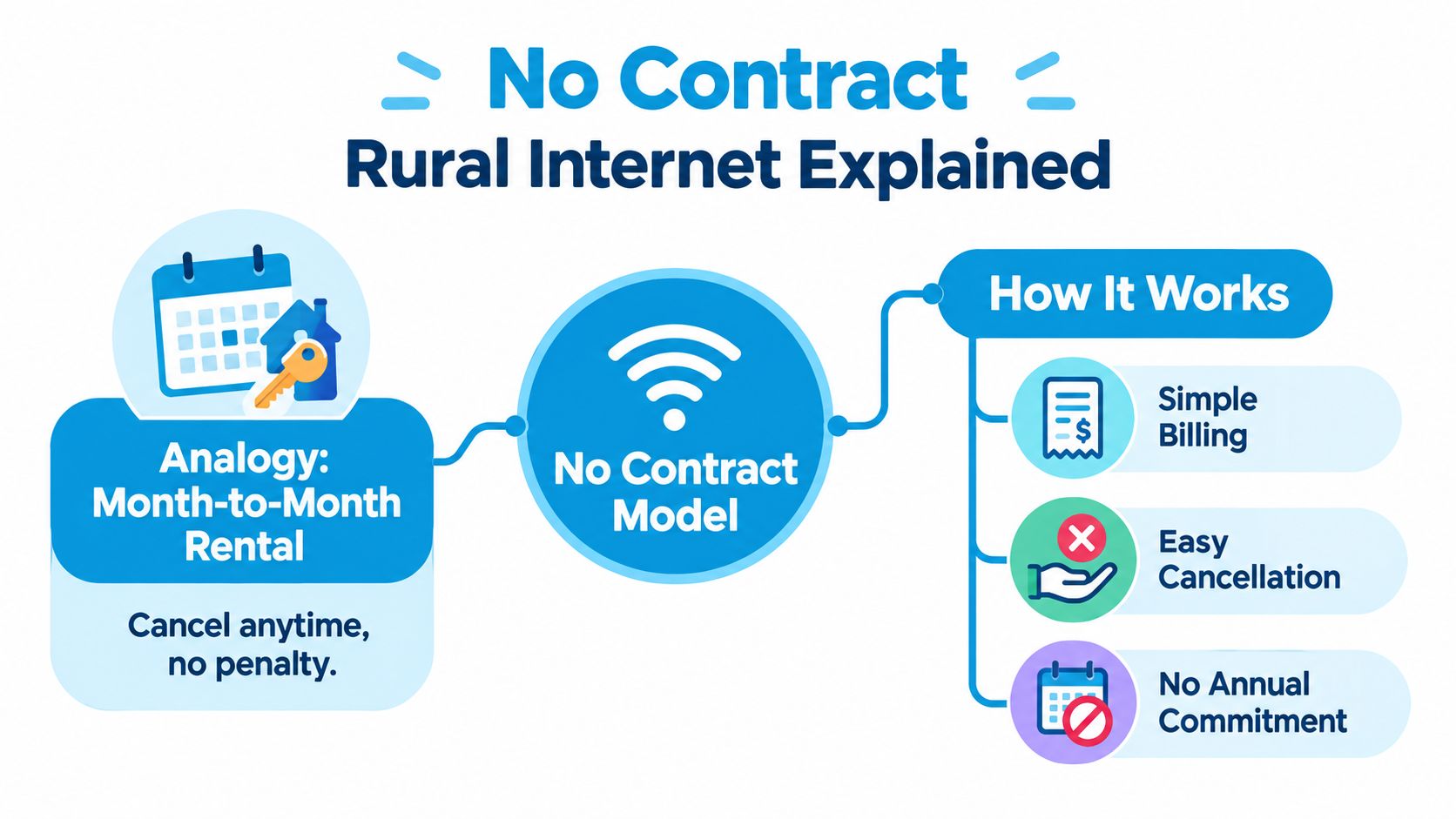
A yearly lease locks you in for a term. Leaving early can cost you. A month-to-month rental gives you more freedom, but you still need to read the rules about deposits, notice periods, and what happens to the keys. No-contract rural internet works the same way.
What it usually includes
Most no-contract plans mean you pay month to month and can cancel without an early termination fee. That's the part people notice first, and it is valuable. If the signal at your home is weak or your RV route changes, you're not tied to a long service term.
But flexibility has layers. Some plans are simple month-to-month service. Some are prepaid, where you pay before use. Others advertise no contract but still include financed hardware, nonrefundable activation, or proprietary equipment that isn't useful elsewhere.
No contract is not the same as no exit cost
A buyer often gets tripped up here. A provider can say there's no service contract and still leave you with costs when you stop.
Look for these details:
- Device financing. If the router or hotspot is paid off over time, leaving early may mean you still owe for the device.
- Proprietary gear. If the equipment only works on that provider's setup, you may not be able to reuse or resell it easily.
- Notice requirements. Month-to-month doesn't always mean same-day cancellation.
- Installation or setup charges. Those may not come back to you even if you cancel quickly.
No-contract service gives you billing flexibility. It doesn't automatically guarantee equipment flexibility.
Month-to-month versus prepaid
These two get mixed together, but they're not identical.
| Option | How it usually works | Best fit |
|---|---|---|
| Month-to-month | Active service renews each billing cycle unless you cancel | Home users, remote workers, RVers who want continuity |
| Prepaid | You load service in advance for a set period | Short stays, backup internet, highly seasonal use |
A month-to-month plan may feel smoother for a household because the connection stays active unless you stop it. Prepaid can be useful when you only want service during certain trips or months.
What to ask before you sign up
Before you buy, ask one direct question: If I leave after a short test period, what costs remain?
That question cuts through most marketing. If the answer includes unfinished device payments, hard-to-return equipment, or setup fees, then the plan is flexible on paper but not fully flexible in your wallet.
Benefits and Tradeoffs of Going Contract Free
No-contract rural internet solves real problems, but it's not automatically the right answer for every home or every traveler. The smartest choice comes from weighing convenience against the costs and performance risks that show up later.
Where contract-free service helps most
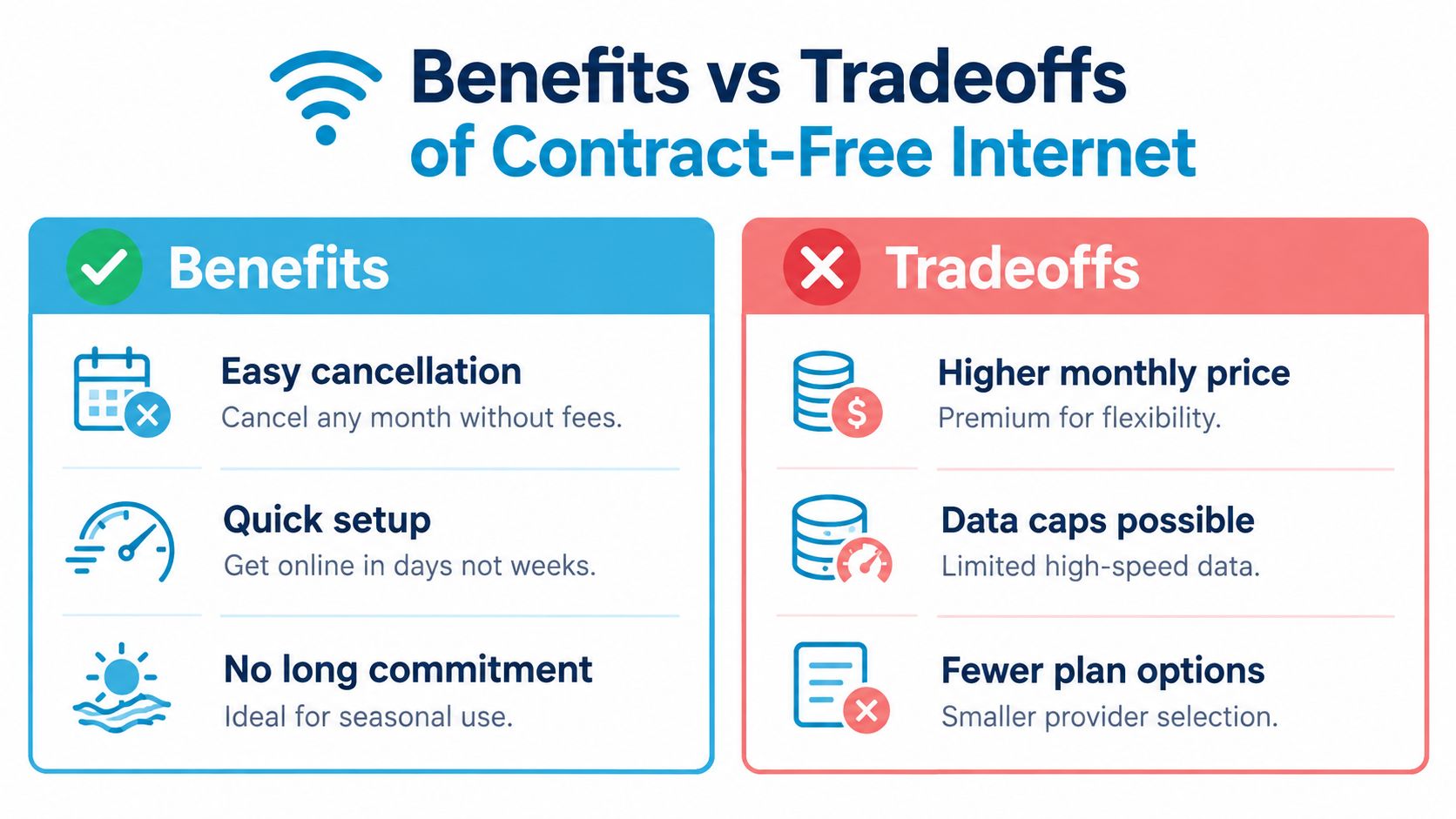
The biggest advantage is freedom to adapt. If your local tower gets congested, your campground has poor signal on one carrier, or a wired build finally reaches your road, you can change plans without waiting out a long term.
That's especially useful in rural areas because network quality can vary more by exact location than by provider brand. Two homes on the same road can have very different experiences if one sits behind trees or in a low spot.
Here's where no-contract service shines:
- Moving often. Good for renters, seasonal workers, and RV travelers.
- Needing internet fast. Wireless setups can often get you online much faster than waiting for a wired install.
- Testing before committing. You can treat the first month like a live trial in your real environment.
- Using internet seasonally. A hunting cabin or vacation property may not need a year-round agreement.
Where the tradeoffs show up
The downside is uncertainty. Your bill may be simpler than a contract plan, but your connection may be less predictable depending on network conditions, local coverage, and the hardware you use.
Recent reporting highlights why that matters in rural areas. Ookla's 2026 analysis found that rural fixed wireless users across AT&T, Verizon, and T-Mobile had lower median download speeds and higher multi-server latency than urban users, with urban subscribers seeing 7 to 13 ms lower latency, according to the Ookla rural versus urban FWA analysis. That latency gap matters for video calls, VPN work, and cloud apps even when download speed sounds fine.
A plan can look good on paper and still feel slow in use if latency is high.
Pros and cons side by side
- Benefit: Easy cancellation. Useful when coverage changes, travel routes shift, or a better local option appears.
- Tradeoff: Hardware can complicate your exit. The service may be flexible while the device cost is not.
- Benefit: Quick setup. Wireless internet can fill a gap while you wait for a fixed line.
- Tradeoff: Coverage can vary block by block. Rural terrain, tower load, and building materials affect real performance.
- Benefit: Good fit for backup use. Many households keep a wireless option for outages or storms.
- Tradeoff: Performance can swing at peak times. Evening streaming hours may feel different than midmorning testing.
A simple way to decide
If your life is stable and you have a strong wired option, a long-term arrangement can sometimes be easier to live with. If your location, usage, or mobility may change, contract-free service often buys peace of mind even when it asks you to pay closer attention to hardware and coverage.
Key Features to Evaluate Before You Choose
Most rural internet mistakes happen before checkout. People compare advertised speed, monthly price, and maybe a coverage claim. Then the device arrives, and issues show up: weak indoor signal, laggy video calls, unusable evenings, or gear that can't move with them.
A better approach is to score every option against the same five checks.
Start with coverage, not promises
Provider maps are useful, but marketing language can blur the difference between “service available somewhere nearby” and “service works well at your exact spot.” For mobile-based internet, the FCC says its Mobile Broadband Map shows 3G, 4G, and 5G coverage for each mobile provider in the area displayed, which makes the FCC Mobile Broadband Map consumer page a practical place to verify local wireless availability.
If you're traveling, check the places you use most, not just your billing address. Home driveway, barn office, campground, storage yard, and common travel corridors can all behave differently.
Speed matters, but latency changes how internet feels
A lot of buyers fixate on download numbers. That matters for streaming and large downloads, but latency is what affects responsiveness. It's the delay between your action and the network's response.
Think of it this way:
- High download speed helps fill a water tank faster.
- Low latency helps the faucet react the instant you turn it.
For work and travel use, low latency improves video calls, remote desktop sessions, VPN responsiveness, gaming, and cloud-based software. Rural fixed wireless can work well, but conditions vary enough that a quick speed test at noon doesn't tell the whole story.
Watch the policy details around data use
Some plans are generous for everyday use. Others slow down after a threshold, prioritize some traffic differently, or perform well until the local tower gets busy. Read for words like “throttling,” “deprioritization,” “network management,” and “premium data.”
If you're comparing portable options, a guide to no-contract mobile hotspot plans can help you see how hotspot-style service differs from a full home router setup.
Check whether the hardware helps or traps you
The device is part of the internet plan, not an afterthought. A strong router or hotspot can make setup simple. A bad equipment choice can create hidden lock-in.
Ask:
- Can you reuse the device if you move?
- Can you return it easily?
- Does it support external antennas if your signal is weak?
- Is it built for a fixed home location, travel, or both?
Support matters more in rural service than many people expect
In cities, a poor provider can sometimes be replaced quickly. In rural areas, your alternatives may be thin. That makes setup help, troubleshooting, and cancellation clarity much more important.
Here's a simple checklist you can use while comparing plans:
| Feature to Check | What to Look For | Why It Matters Rural and RV |
|---|---|---|
| Coverage verification | Independent map check plus address-level confirmation | Rural signal can change by road, hill, or campsite |
| Latency | Consistent responsiveness during work and evening hours | Affects calls, VPNs, gaming, and cloud apps |
| Data policy | Clear terms on slowdowns, prioritization, and heavy use | Prevents surprises after streaming or work bursts |
| Hardware flexibility | Reusable device, fair return policy, travel-friendly design | Reduces hidden exit costs if you move |
| Support access | Easy contact options and clear setup help | Faster fixes matter when alternatives are limited |
Test where you actually use the internet. The kitchen table, metal RV shell, and back office can produce very different results.
How Different No Contract Options Fit Real Rural Needs
One reason rural buyers get overwhelmed is that the same internet technology can fit one lifestyle well and feel wrong for another. A router that works nicely in a farmhouse may be awkward in an RV. A hotspot that's perfect for a solo traveler may struggle in a busy household.
The household setup
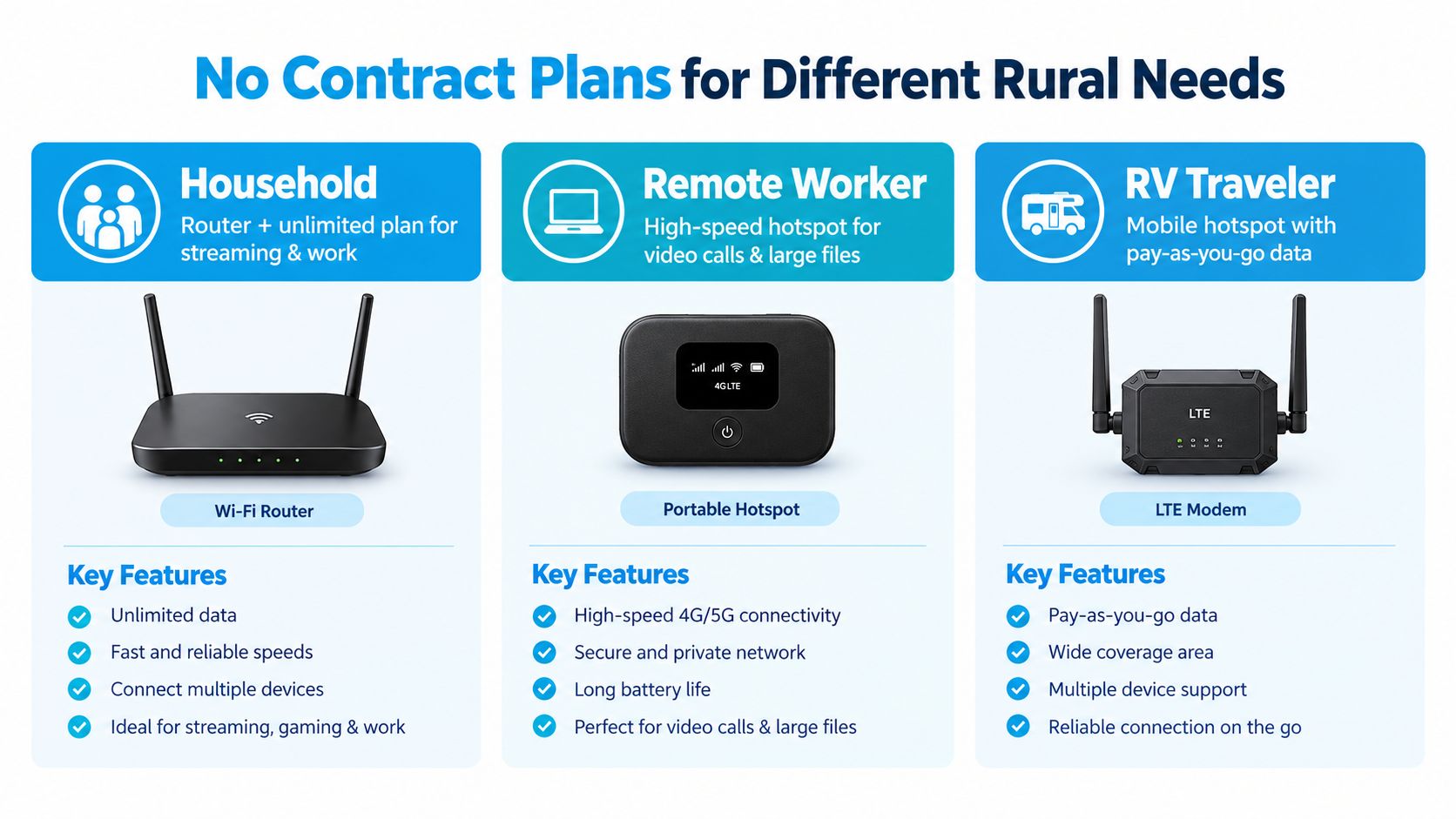
For a rural home with multiple people, a dedicated router setup usually feels more normal. It stays in one place, covers more space, and handles smart TVs, laptops, tablets, and home devices more smoothly than a small hotspot.
This is often the best fit if your household streams regularly, works from home, and doesn't move the equipment around. A home-based wireless plan also makes sense while you wait for a wired build in your area. Federal policy delays are part of that reality. Reporting on rural broadband funding noted that about $21 billion in BEAD funding was still delayed while states waited for guidance, according to Michigan Public's report on delayed BEAD guidance.
The remote worker setup
A remote worker in a rural cabin or outbuilding usually needs more than “basic internet.” They need a connection that stays responsive in meetings and doesn't fall apart under VPN use.
That's where a stronger hotspot or router with flexible carrier access can help. SwiftNet Wifi is one example of this type of setup. It offers 4G and 5G no-contract plans using virtual SIM connectivity across AT&T, Verizon, and T-Mobile for home and mobile use. The practical value isn't the label. It's having a setup designed around carrier flexibility rather than a single-network assumption.
For people comparing rural coverage patterns more broadly, this guide to internet for remote areas can help frame what kinds of equipment tend to fit harder-to-serve locations.
The RV and mobile setup
RV users need to think differently. The main question isn't just “Do I have coverage today?” It's “Will this still work after I cross into a new county, camp under trees, or stop in a crowded seasonal area?”
That's why many travelers prefer equipment that's easier to reposition and service that isn't tied too tightly to one location. If your route changes often, multi-carrier flexibility matters more than a polished signup page.
For RV life, reliable internet often comes from adaptability, not from picking one provider and assuming it will behave the same everywhere.
Hotspot versus router in real life
| Use case | Usually fits better | Why |
|---|---|---|
| Family home | Router | Better whole-home coverage and device handling |
| Solo remote worker | Hotspot or compact router | Easier to place where signal is strongest |
| RV traveler | Portable hotspot or travel router | Easier to move, test, and use across locations |
The right choice depends less on the name of the plan and more on whether your internet stays in one place, follows you on the road, or has to do both.
How to Choose the Right No Contract Plan With Confidence
Buying rural internet gets easier when you stop trying to find the perfect plan and start trying to find the lowest-risk first step. That shift matters. You're rarely choosing a forever connection on day one. You're choosing a practical setup that fits your location, your routine, and your ability to leave if it underperforms.
Use a simple decision path
Start with location reality. If your home or RV stops spend time in weak-signal areas, verify coverage before you compare features. An attractive plan with poor local performance is still a poor plan.
Then estimate your usage in broad categories:
- Light use means browsing, email, maps, and occasional video.
- Mixed use adds regular streaming, schoolwork, and work calls.
- Heavy use includes multiple users, streaming on several screens, large uploads, and all-day work traffic.
Compare total cost, not just monthly cost
The “flexibility versus exit cost” idea matters most. Two plans can look similar until you include equipment, setup, returns, and what happens if you move next month.
Use this quick matrix:
| Question | If the answer is yes | If the answer is no |
|---|---|---|
| Can I cancel without a service penalty? | Good sign for flexibility | Read terms carefully |
| Can I leave without owing on hardware? | True exit stays simpler | Device cost may outlast service |
| Can I reuse the equipment elsewhere? | Better for homes and RV travel | You may be buying a dead-end device |
| Can I test it where I actually use it? | Lower regret | Risk is higher |
Think about movement before you buy
A lot of people only ask “Will this work here?” They should also ask “What happens if I leave here?” That includes moving house, changing campgrounds, or shifting from weekend trips to full-time RV living.
Current broadband buildout uncertainty is part of that calculation. Rural deployment timelines still face pressure, and the policy environment continues to move. The FCC's 5G Fund for Rural America is a $9 billion program intended to support 5G buildout in rural areas unlikely to receive unsubsidized deployment, using a reverse auction mechanism, according to the FCC order on the 5G Fund for Rural America. That matters because better coverage may arrive, but not always on the timeline a household needs.
A calm buying mindset helps
You don't need to solve every future internet question today. You need a plan that works well enough for your current life and lets you change course without pain.
Buy your first month like a field test. Use it during work hours, evening streaming time, and in the exact room or RV spots that matter most.
Making No Contract Rural Internet Work for You
The biggest lesson with no-contract rural internet is simple. Flexibility only helps when you keep the exit path clean. A month-to-month bill is useful, but it's not the whole story if the device is hard to return, tied to financing, or locked to a setup that doesn't travel well.
Rural internet choices also make more sense when you match them to your real life instead of to marketing labels. A family home may need a steady router setup. A solo traveler may do better with a portable hotspot. A remote worker may care more about call stability and latency than raw download speed.
The coverage gap is still real in rural America. The FCC's most recent reporting shows approximately 28% of rural areas still lacked fixed broadband at 100/20 Mbps, and about 36% of the rural population lacked 5G-NR coverage at the FCC's 35/3 Mbps benchmark, according to the Ookla article summarizing current rural broadband gaps. So the question often isn't whether flexible wireless internet is relevant. It's how to choose it carefully.
If you're trying to stretch data on a mobile or rural plan, this guide on how to reduce data usage can help you make any connection go further.
The low-regret path is to verify coverage, compare true total cost, test the service where you'll use it, and avoid hardware decisions that trap you. That approach works for farmhouses, cabins, RVs, and backup setups alike.
SwiftNet Wifi offers no-contract 4G and 5G internet for rural homes, RV travelers, and mobile users, with multi-carrier connectivity across major nationwide networks, a 7-day risk-free trial, and straightforward plan options. If you want a flexible setup that fits the kind of coverage and exit-cost questions covered here, visit SwiftNet Wifi and compare whether a hotspot or router plan matches how you live and travel.
Read more at SwiftNet Wifi #rv #rvlife #rvliving #rvlifestyle #rvrenovation #rvremodel
#rvtravel #rvcamping #rvadventures #ruralwifi #5gwifi
#5ginternet


